Water Management in Iran as Internal Colonialism

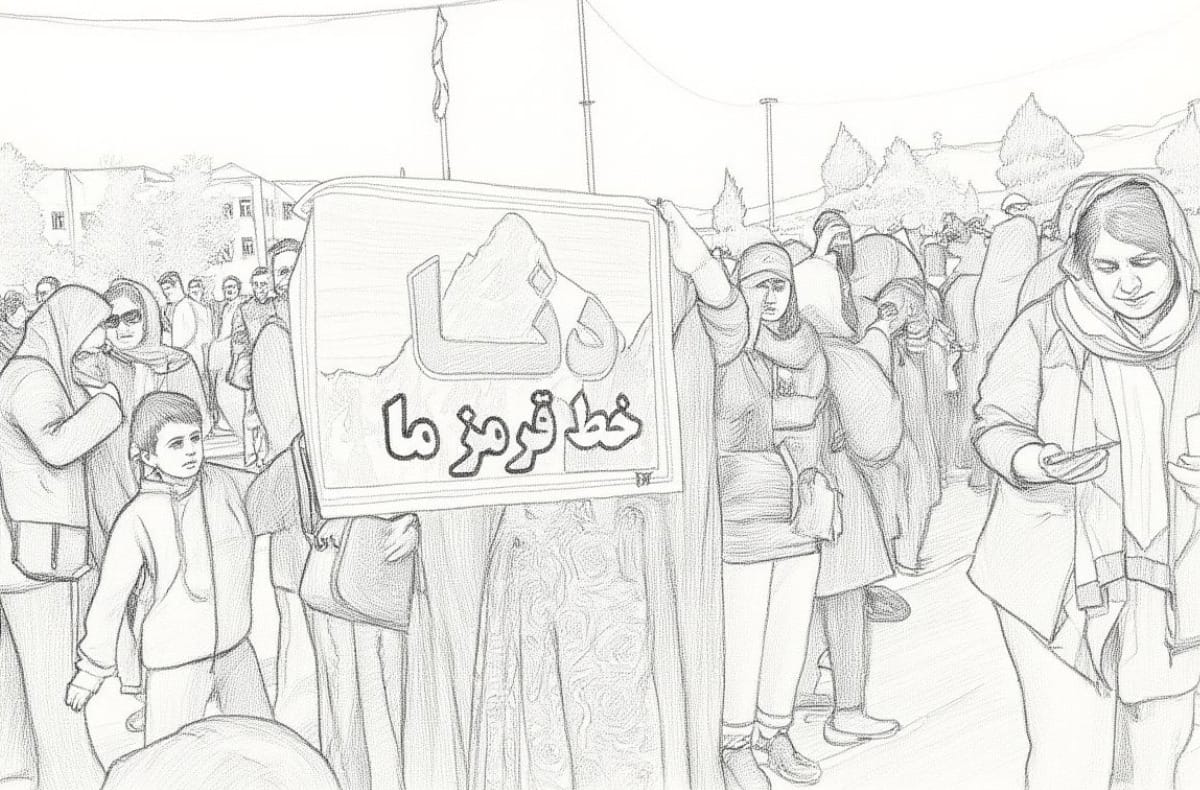
In late November 2025, outside the Governorate of Kohgiluyeh and Boyer-Ahmad in Yasuj, a scene unfolded whose very plainness made it one of the most condensed images of the water–development–power nexus in Iran today. ISNA reports that “the people of Yasuj, the provincial capital of Kohgiluyeh and Boyer-Ahmad, held a gathering in opposition to the construction of the Mandegan Dam and Khersan 3”; a protest that took shape, following a call by “student–popular associations”, in Imam Hossein Square and in front of the governorate building.
Various news outlets referred to the participation of “different segments of the public,” “environmental activists,” “educators,” “students,” and even demonstrators who had come from Chaharmahal and Bakhtiari—people holding placards against the Mandegan and Khersan 3 projects, speaking about the fate of the Dena, the Karun, and the downstream villages.
To grasp what is at stake in this moment, one has to step back from the immediate surface of a local protest over “two infrastructure projects.” The dispute is indeed about two specific dams, but at a deeper level, it turns on a larger question: in today’s Iran, who is made to bear the cost of “sustainable water provision” for industrial and political centers? Who gives the water, and who consumes it? And what kind of power is being consolidated through this reallocation of water?
Two Dams, One Shared Pattern
This article draws on the available data on the Khersan 3 Dam, the Mandegan Dam, the state of water stress in Kohgiluyeh and Boyer-Ahmad, and the broader pattern of dam-building and inter-basin transfers from the Zagros toward Iran’s central plateau, in order to read the Yasuj scene as a lucid instance of “internal colonialism” in Iran: colonialism not in the sense of an external occupier, but in the sense of converting a peripheral region into a reservoir of water and labor for the country’s centers of power and wealth.
Khersan 3, a mega-dam on the headwaters of the Karun: According to the official data of the Iran Water and Power Resources Development Company, Khersan 3 is a thin double-curvature concrete arch dam on the Khersan River, with a height of roughly 195 meters, a reservoir volume of about 1.15–1.18 billion cubic meters, and an installed power generation capacity of 400–410 megawatts. [Interactive map of the Karun River and its branches]
The dam is situated upstream of two other dams (Khersan 1 and 2) and within one of the Karun basin’s principal sub-catchments. The geography of the project is such that a substantial portion of the reservoir lies within Kohgiluyeh and Boyer-Ahmad, adjacent to Luri-speaking villages—within the very zone long described as among Iran’s most water-abundant regions.
Local and provincial reporting renders the project’s social footprint more legible. ISNA and regional outlets speak of at least 17 to 21 villages being submerged as Khersan 3 is impounded, estimating that around 800 households will be forced to abandon their homes and land. These reports—juxtaposing images of houses and agricultural plots located in the reservoir’s path with repeated emphasis on the destruction of orchards, rangelands, and access routes—produce a stark picture of the project’s “local cost.”
Beyond the immediate locality, Khersan 3 belongs to a larger chain. Alongside projects such as Beheshabad and Kouhrang 3, it is framed as one of the main corridors for transferring water from the Karun headwaters in the Zagros to the central plateau (Isfahan, Yazd, Kerman, and beyond): a chain intended to compensate for water shortages in major cities and industrial zones, but at the price of altering the hydrological and social regimes of the source regions.
Mandegan, a dam without permits in the heart of Dena: The Mandegan Dam is being built on the Marbor River, within the Dena Protected Area—an area registered both as a national park and as a UNESCO Biosphere Reserve, and one of Iran’s most diverse mountain ecosystems.
The key point about Mandegan is that, unlike many comparable projects, it has not even passed through the state’s own minimal—and often flimsy—technical review rituals. Multiple reports confirm that the dam “has no environmental permit,” yet it has moved into tendering and execution without the completion of environmental and social impact assessments and without clear legal approvals.
A Tasnim report—Tasnim being a news agency widely described as close to the IRGC—has also drawn the Ministry of Interior into the file: tenders were held despite the project’s lack of authorization, turning the issue into a national-level case. Environmental specialists have warned about tree cutting, the destruction of wildlife habitats, shifts in the Marbor River’s flow pattern, and long-term impacts on the local microclimate.
In official documentation, the stated purpose of the Mandegan Dam is primarily to supply drinking water and agricultural water for neighboring provinces—especially Isfahan. In other words, water is extracted from the heart of Dena and the Zagros so that, further east, it can be folded into the circuits of major cities, water-intensive cultivation, and industry.
Yasuj: A Revolt Against the Model
When the people of Yasuj gathered in Imam Hossein Square in late November 2025, their slogans and placards were not merely directed at “two dams.” An ISNA report quotes one demonstrator who had traveled from Chaharmahal and Bakhtiari to Yasuj:
“The Zagros regions have the most water, while four out of every five jobs are directly tied to water. Yet these same regions have the highest unemployment, and Zagros youth—because of joblessness—have ended up riding shooti.”
That single statement compresses several crucial axes into one frame: the concentration of water resources in the Zagros; the direct dependence of local livelihoods on water (farming, orchards, pastoralism); unemployment and job insecurity in precisely those areas that supply the water; and the pushing of young people into an informal, precarious, and often dangerous economy (the shooti economy and related forms of high-risk survival work).
From this vantage point, the gathering outside the governorate is not simply an objection to “environmental destruction” or “tree cutting.” It is an objection to a structural model in which mountainous and rural regions are assigned the role of raw-resource reservoirs for other parts of the country, without receiving the corresponding economic dividends: durable employment, infrastructure, and public services.
At the same time, the media coverage of the protest itself reveals a contradiction. On the one hand, reports emphasize that the gathering formed “following a call by student–popular associations” and that “different segments of the public” were present. On the other hand, the interpretive frame is narrowed to the register of “environmental concerns”: anxiety about Dena, about biodiversity loss, about tourism.
This localization of the issue sits uneasily with a reality the state itself openly acknowledges. In a cabinet decision taken a few weeks before the protest, the president reportedly ordered the “acceleration of the implementation and completion of the Kouhrang 3, Khersan 3, and Mandegan dams to ensure the sustainable supply of drinking water for the central provinces, especially Isfahan and Yazd.”
Put plainly: in Tehran, these dams are treated as strategic national projects designed to “rescue” the center; in Yasuj, they are expected to remain a merely “local” matter—something to be settled with a handful of technical meetings and promises of village relocation.

A Water-Rich Province, Thirst-Driven Communities
To grasp the weight of this contradiction, we have to step back. For much of the past decades, Kohgiluyeh and Boyer-Ahmad have been counted among Iran’s most water-rich provinces. The Zagros range, snow-laden highlands, springs, and rivers such as the Bashar and the Marbor have effectively turned the province into one of the country’s major water sources. Yet at the very same time, official and semi-official reporting has been registering a different reality for at least a decade:
- From the mid-2010s, domestic media repeatedly reported that many of the province’s villages were being supplied by water tankers.
- In late November 2025, amid the debate over the dams, Kabna News published a report under the headline “When the Tanker Replaced the Water Network,” describing villages in the Souq district of Kohgiluyeh County whose water had long been provided by a spring in Dezhkouh—until declining rainfall and reduced discharge made even temporary tanker deliveries insufficient, turning the situation into a full-blown crisis.
These details bring a second picture into focus: in the very province whose river systems are slated to be impounded behind mega-dams and transferred toward the central provinces, dozens—indeed hundreds—of villages still lack a stable and safe drinking-water network. When protesters in Yasuj speak of “the most water-abundant city in Iran” facing repeated water cuts, this is not merely a mood or a rhetorical flourish; it is the lived expression of a structurally documented reality.
Here, water’s value is defined as an input within the chain of capitalist production and reproduction. Within that definition, it becomes almost “natural” that mountain and village water—so long as it is used for drinking and small-scale agriculture—counts as less valuable than the water delivered to steel complexes, petrochemical facilities, or densely populated urban zones. Infrastructure is then organized accordingly: where the “economic payoff” is higher, pipelines are built; where it is not, people are left with “tankers” and “patience.”
The Ecosystem as “Unconsumed” Periphery
Khersan 3 is only one link in a chain that has already transformed—and will continue to transform—the fate of the Karun and Khuzestan. In recent years, academic studies have argued that the cumulative complex of dam construction and inter-basin transfer schemes on the headwaters of the Karun and Karkheh has played a substantial role in the desiccation of wetlands, the reduction of river flows, and the intensification of dust-storm hotspots in Khuzestan.
Drawing on thirty-year datasets on precipitation, river discharge, wetland surface area, and satellite imagery, these studies trace a pattern in which every new upstream dam/transfer link reduces the downstream ecosystem’s resilience. As wetlands dry and soil moisture declines, new surfaces become dust sources; dust, in turn, becomes yet another barrier to life, agriculture, and public health in Khuzestan.
In the case of Mandegan and Dena, the central problem may not appear—at first glance—to be “floods” or “major rivers,” but rather the degradation of a fragile mountain ecosystem. Dena is not merely a “beautiful landscape”; it functions as a regulator of the local climate. Its forests, vegetation cover, soils, species diversity, and the regime of surface and subsurface flows all shape the balance of rainfall, temperature, and humidity across the region. Building a dam—without serious assessment—at the heart of such an area amounts to tampering with a climatic regulator while lacking any clear, evidence-based picture of the medium- and long-term consequences.
Within this structure, peripheral ecosystems—forests, mountains, wetlands—are recognized as “resources” only insofar as they can be mobilized to satisfy demand at the center. When a dam or a road is to be cut through a forest, or when a gas/oil/water transfer pipeline is to be laid beneath a wetland, “development” suddenly arrives there. Yet the same ecosystem, when the question becomes protection, restoration, or the right of local communities to use it sustainably, is recast as “costly” and “an obstacle to development.”
Internal Colonialism: What the Khersan Dam Reveals
The concept of “internal colonialism” is used here to describe a condition in which the central state governs certain regions—ethnically, geographically, or in class terms—as if they were colonies within the country’s formal borders: through resource extraction, intensified security control, limited investment in public services, and an infrastructure regime oriented primarily toward transferring resources to other regions.
Read through this lens, several features of Iran’s present condition—and of the Zagros in particular—come into sharper relief:
- The centralization of decision-making and ownership over water and energy resources
The fate of projects such as Khersan 3 and Mandegan is determined within the Ministry of Energy, the Plan and Budget Organization, the cabinet, and a network of contracting and consulting firms largely based in Tehran or other major provincial capitals. In this process, the people of Yasuj—and villages such as Marbor or Sadat Mahmoudi—are displaced from the position of primary decision-makers into the position of those for whom decisions are made. - A structural disregard for local livelihoods within the “development” equation
Under this model, the social costs of dam-building are reduced to a few standardized clauses: village relocation, compensation payments, the construction of an alternative road. What happens when a mountain village is uprooted—the tearing of social networks, the disruption of the local economy, the loss of situated knowledge tied to land and water, and the conditions of intergenerational reproduction—has no place in the cost–benefit calculus. - A center/periphery dualism in the distribution of risk and benefit
The benefits of dams (drinking water, agricultural water for industrial hubs, electricity) flow disproportionately to places that were already centers of political and economic power. By contrast, the risks—ranging from flooding and land subsidence to unemployment, migration, dust storms, and soil erosion—are concentrated in the periphery. - Technical and security language as political cover
Here the colonial reflex appears in familiar form: whenever local protest against such projects intensifies, the official response typically combines technocratic language (“all studies have been completed,” “the project has been approved by specialized committees”) with security language (“preventing disruption of public order,” “enemy exploitation”). The political question—who decided, and who is made to pay—is concealed beneath a barrage of engineering and policing terminology.
What protesters in Yasuj articulate makes this pattern almost pedagogically transparent:
Above: a cabinet resolution to “accelerate implementation” in order to secure a stable water supply for Isfahan and Yazd. Below: villages still queuing for tanker-delivered water, and demonstrators who—without any academic vocabulary—say their youth have been pushed by unemployment into the shooti economy. On one side, the dam is framed as a “vital national project”; on the other, there is a daily life that lacks even minimal infrastructure, yet is expected to bear the cost of that very “national project.”
This relationship between extraction and the erosion of local life-worlds often unfolds in provinces where Kurdish, Arab, Baluch, and Turk citizens live. It adds an ethno-national layer to other forms of inequality, indicating how the resources and livelihoods of these citizens are sacrificed to other interests—an “other” frequently coded as Persian-speaking, and as an identity and positionality that, within this unequal arrangement, is cast in the role of colonizer/occupier.
“Internal colonialism” here is not merely a political metaphor. It describes a condition in which the Zagros and its inhabitants are simultaneously defined as a “resource” and as a “periphery.” A resource, because their water, electricity, and land are mobilized to resolve crises at the center; a periphery, because in decision-making, budget allocation, and access to durable infrastructure, they are placed last in line.
It is within this same framework that local people are often addressed as though they lack even the capacity to comprehend what is happening: a handful of technical terms and the recycled sentence—“all studies have been completed”—is treated as sufficient to quell protest and restore the vertical relation from above to below; as if the proper role of the local population is, at best, to listen and go home, rather than to be an equal partner in deciding the fate of the very water and land on which their lives depend.
A map of the Central Zagros watershed and the dense concentration of dams across the region. Khersan 3 Dam is located south of Lordegan County, directly south of Mount Rag.
Neoliberal Water Governance and the Contractor Economy
If we peel back one more layer, we have to look at the particular blend of “water neoliberalism” and Iran’s contractor-driven political economy. In Iran, almost all major dams remain state-owned, and the Ministry of Energy itself stresses in an internal study that both the construction and ownership of dams have, in practice, remained public to this day. Only a handful of small agricultural dams have been built with private capital—and even those have repeatedly generated controversy because of legal grey zones around ownership and permitting. In other words, the outright sale of dams is not yet the policy horizon.
Yet the same study insists—at the same time—on something else: the expansion of the non-state sector’s role across every layer surrounding the dam. In upstream policy frameworks such as the general policies of Article 44 and the Fifth Development Plan (2011–2016), room is created for transferring investment, operation, and even parts of ownership of water facilities to non-state actors, on the condition that the “rights of water-right holders” are preserved. In practice, this does not mean selling the concrete body of the dam. It means what we can call a dam-contractor economy: outsourcing maintenance, repairs, operational services, security, site management, “water tourism,” aquaculture, and even parts of power generation to a web of private and quasi-private firms.
From the 1990s onward, water policy has increasingly moved toward commercialization, pricing, and the redefinition of water as an “economic good.” At the same time, a large share of dam-building, network expansion, and inter-basin transfer projects has been awarded through contracting arrangements to major consortia. Several features of this configuration are visible in the Khersan 3 and Mandegan cases:
- Pressure to “economically justify” projects
The rationalization of projects that cost several billion dollars is performed in feasibility reports through numbers and charts that translate produced energy, delivered water, and direct/indirect employment into monetary terms. The loss of a village, the erasure of a way of life, or the degradation of a mountain ecosystem is either treated as “non-quantifiable” or relegated to a marginal figure in the accounting. - A networked dependency of contractors, consultants, and managers on the continuation of projects
Halting a dam at its current stage means losing major contracts, undermining the political capital of managers who have branded the project as an “achievement,” and disrupting the interests of companies that profit across design, implementation, procurement, and equipment supply. This lattice of interests generates powerful incentives to sideline environmental safeguards, to rush tenders for a project lacking permits (as with Mandegan), and to resist local opposition. - The language of crisis and emergency
To push such projects through, the state and contractors need a logic of permanent crisis: a water shortage crisis in Isfahan and Yazd, an electricity crisis, an industrial growth crisis, an employment crisis. Within this logic, environmental damage in the source region is framed as “secondary” or “manageable,” while any project delay is cast as “catastrophic” and “irreparable.”
This combination reveals yet another face of internal colonialism: peripheral regions are not only reservoirs of water and energy; they are also fields of contractor accumulation—spaces where contractor capital, backed by political rents and quasi-state mechanisms (شبهدولتی), can extract profit from “infrastructure development” without ever having to enter a genuine social negotiation with local communities.
Iran’s primary pole of industrial production is the Tehran–Central Plateau macro-region (Tehran/Alborz/Qazvin/Isfahan/Markazi/Yazd/Semnan), where a large portion of industrial value added and factory concentration is clustered—while a significant share of energy-intensive industries and raw-material processing is located along the southern and western peripheries.
Migration, Unemployment, and Displaced Bodies
Another part of the picture is migration and unemployment—the point where “peripherality” translates directly into numbers and percentages. Recent reports by Iran’s Statistical Center show that in autumn 2023, four of the five provinces with the highest unemployment rates sit in this same peripheral belt: Sistan and Baluchestan (12.5%), Khuzestan (11.9%), Kermanshah (11.8%), and Lorestan (11.5%). In other words, the geography of chronic unemployment largely overlaps with the geography of an ethno-regional periphery.
By spring 2025, Khuzestan—at an unemployment rate of 12.4%—was officially described as the country’s “unemployment capital,” while the national average stood at 7.3%. In the same reporting, Kohgiluyeh and Boyer-Ahmad appears among the provinces classified as having a “high unemployment rate” and as being caught in a “chronic cycle of unemployment and out-migration”—a cycle that the Statistical Center’s own data lays bare even when local officials try to cosmetically reframe it.
In Kohgiluyeh and Boyer-Ahmad, the micro-level landscape confirms the same pattern. A young, educated population faces a labor market whose main pillars are the public sector, a few major infrastructure projects, and a web of small-scale service jobs. Agriculture and orchard cultivation—once the backbone of livelihoods—have been steadily pushed, under the combined pressure of drought, climate change, declining spring and river discharge, and soil erosion, from a “means of subsistence” into a high-risk, low-income activity. Official environmental reporting has, in recent years, recorded alarm signals about the degradation of Zagros forests—triggered by just a few degrees of warming and the repetition of droughts over a short span. As the protester from Chaharmahal and Bakhtiari put it at the Yasuj gathering, in regions where “four out of every five jobs are directly dependent on water,” once water itself is transformed into a scarce, unstable, transferable commodity, unemployment ceases to be a temporary fluctuation and becomes a structural condition.
In this context, the wave of migration toward central cities such as Isfahan, Shiraz, Tehran, and others is not merely an “individual choice.” It is a rational response to the architecture of an economic order in which the Zagros’s natural resources are extracted at high intensity, while investment in social reproduction—durable infrastructure, diversified industry, and high-quality public services—remains minimal. Regional studies on the Central Zagros have documented this combination for years: intense rural-to-urban migration, population concentration in a handful of cities, and chronic inadequacy in the distribution of facilities and services.
The result is what planning discourse often calls “uneven development.” But behind that term lie far more concrete displacements of bodies and lives: working-age populations leave the Zagros and are absorbed into large cities as cheap labor—informal, precarious, and easily replaceable. Those treated as “surplus” within the developmental calculus of their birthplace reappear on the margins of Isfahan, Shiraz, or Tehran as day laborers, shooti drivers (high-risk informal transport), street vendors, or contractless service workers. Geographic “periphery” is translated into social and economic “periphery.”
Within this dynamic, dam construction and water transfer play a double role. On the one hand, by altering water and land regimes, they erode rural and agrarian livelihoods: lands once cultivable under natural flows are either submerged or become unreliable as discharge declines and groundwater levels fall. On the other hand, these same projects—through the promise of temporary wage work during the construction phase—absorb part of that young population for a few years.
The governor of Kohgiluyeh and Boyer-Ahmad has himself acknowledged that with the completion of two “mega-projects”—the Gachsaran petrochemical complex and the Chamshir Dam—the projects’ labor force was thrown into unemployment and the province’s unemployment rate rose. In other words, project-based employment, the moment construction ends, converts into a new wave of joblessness. After the project is finished, what remains is the reservoir, the power plant, and contractors’ settled contracts—not stable employment for the very workers who were once presented as the project’s “local advantage.”
Focal Point of Contradictions
If we return to the opening scene of the protests in Yasuj, we can see why this gathering is simultaneously “local” and “national.” It is local because it speaks to the water, land, and everyday life of people in a specific province. It is national because it confronts two projects that the cabinet has declared necessary for “ensuring a sustainable water supply for the central provinces.”
At this point of intersection, multiple fractures become visible at once: the rift between infrastructure-led development and ecosystem protection; the rift between the profit-oriented logic of the contracting economy and the logic of sustainable livelihoods; the rift between the central state and local society; and, ultimately, the rift between the official image of “national resources” and the lived experience of those who reside alongside those very resources.
In the media coverage of the gathering—within an Iranian media structure that often reads such events through a security lens—these fractures are pushed into the margins, diluted into phrases like “environmental concerns” and “drinking-water supply.” Yet on the ground, it is precisely these fractures that shape people’s trajectories: from protesting in front of the governorate to deciding to migrate; from distrust in officials’ promises to efforts to build independent networks of information and activism.
Re-reading a Developmental Model
Khersan 3 and Mandegan, by themselves, do not exhaust the entire story of water, power, and inequality in Iran. But their simultaneous concentration within a single province—and the emergence in Yasuj of the first large-scale student–local mobilization against them—makes it possible to see a larger pattern in a form that is empirically observable.
That pattern can be summarized as follows:
- Infrastructure development oriented toward transferring resources to the center
Water, energy, and raw materials are channeled from the Zagros and other peripheral zones toward the central plateau and industrial hubs. Decisions are made in Tehran and other power centers; costs are paid in remote villages. - Structural instability in water access for those living at the source
Zagros villages and small towns—despite being situated near headwaters—face water stress and tanker delivery, even as multi-billion-dollar projects for transferring water out of those very basins proceed. - The dumping of environmental and social risks onto the periphery
The degradation of Dena, the endangerment of the Karun headwaters, the drying of wetlands and the intensification of dust in Khuzestan, the destruction of villages and the production of unemployment—these are concentrated at the source, while the benefits (drinking and industrial water, electricity) are largely absorbed at the destination. - The conversion of the periphery into a reservoir of cheap labor
The same mechanism that moves water toward major industries and large cities also pushes peripheral youth—through the erosion of local livelihoods—toward urban marginality and informal work.
From this angle, the Yasuj gathering is not merely a protest against two dams; it is a rights-claim aimed at redefining the relationship between center and periphery in Iran. It asks what kind of development resources, such as water, mountains, forests, and rivers, are meant to serve—and who should possess real agency in deciding their fate.
“Internal colonialism,” in this text, is not an ideological label but a name for a specific mechanism—one that can be traced across the map of dams, the routes of pipelines, unemployment statistics, reports of tanker-supplied villages, and the voices of protesters assembled outside the Yasuj governorate. Understanding this mechanism is a necessary condition for any serious debate about the future of water, justice, and development in Iran—whether in Dena, in the Karun basin, or in those cities whose distant “salvation” is defined at the price of intensifying crises in these very peripheries.