The Archive of Mourning and Resistance: From Rabia’s Poetry to Naming Femicide
If we want to fight femicide today, we have to do two things at the same time: expose the structure and record the feeling. A legal and political struggle without archiving feelings collapses into statistics; and an archive of feelings without structure dissolves into ineffectual tears.

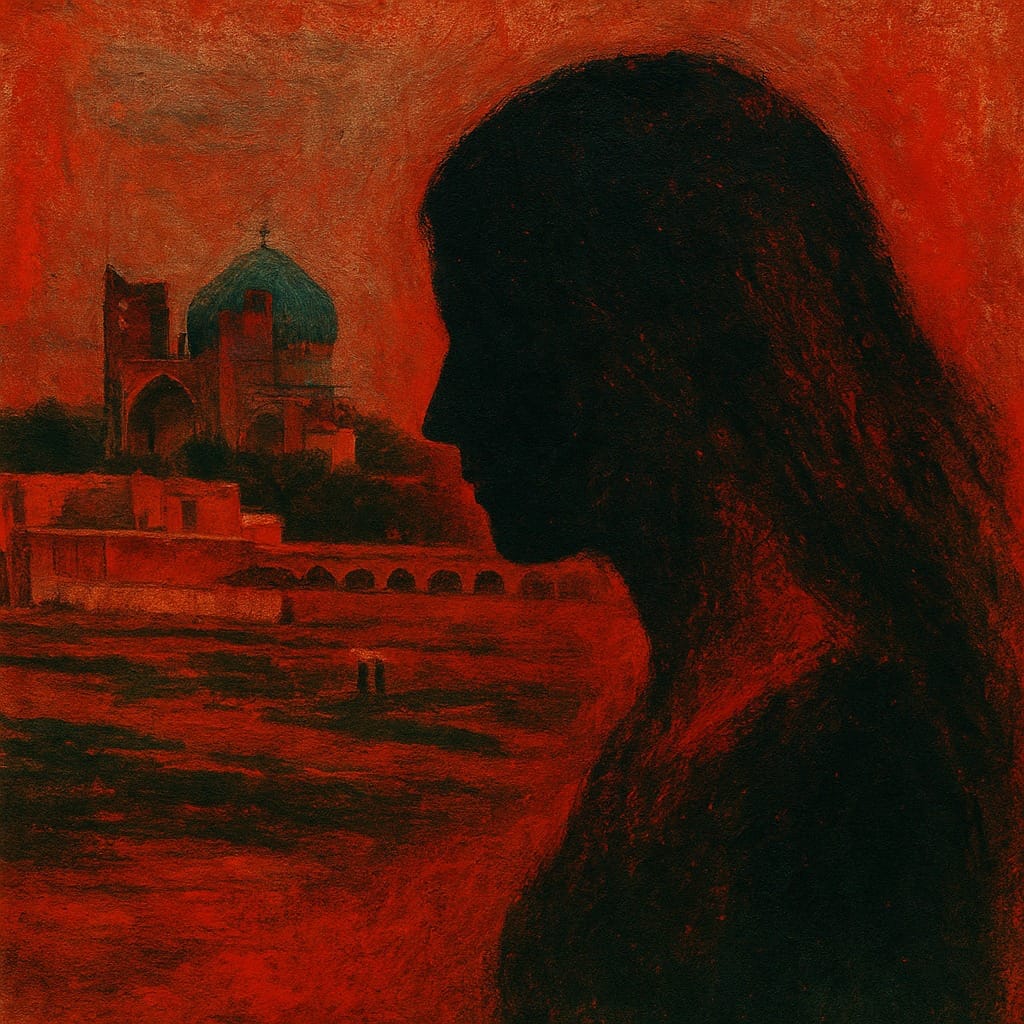
Rabia Balkhi is commonly regarded as the first Persian-language woman poet: a woman from Balkh in the fourth century AH who fell in love, wrote poetry, and was killed by her brother—trapped in a sealed bathhouse, her veins cut open. This is not merely the biography of a poet. It is the account of a chain that still tightens around women’s lives: “honour,” now reproduced with the face and logic of femicide.
This text is written by a man—from the conscious position of a man—looking directly at an old shame: the shame called patriarchy, lodged deep in my language, my upbringing, and my inherited privileges. I write from this vantage not to speak on behalf of women who have been silenced, but to testify against ourselves: against the laws we drafted, the customs we built, the jokes we normalized, and the violence we laundered under the name of “ghayrat” (protective jealousy, masculine honour). This is not a confession meant to lighten a guilty conscience. It is a commitment to loosen the bolts of an old structure—from the private history of the home to the public archive of the city, from the body to the law, from silence to a form of speech that leaves violence no route of escape.
If only scattered fragments of Rabia’s poetry have survived, those fragments are themselves an “archive of feelings,” in the sense proposed by Ann Cvetkovich: living documents of mourning, longing, fear, and hope, documents that preserve the history of the erased outside official, patriarchal archives. What follows is a rereading of Rabia’s story, an attempt to connect it to the present, and a demonstration of how the same millennium-old structure still operates through politics, law, family, and language, and why, unless we take popular archives and archives of feeling seriously, understanding this violence, let alone breaking it, remains impossible.
In the absence of official statistics and of a distinct legal category criminalizing femicide under Iranian law, human-rights estimates over the past year sketch a grim picture: HRANA has documented at least 110 cases of femicide, and Hengaw has recorded at least 176 cases across multiple provinces—figures that, roughly speaking, amount to the killing of one woman every two to three days.
A Name That Passed Through Blood
Rabia Balkhi (also known as Rabia Quzdari) lived in an era when Dari Persian was only beginning to consolidate as a language of poetry. Against an official bureaucratic order that prized Arabic as the proper medium of “high” literature, she wrote in Persian, and not merely panegyric or pious ascetic verse, but love. She came from an eminent family, from the heart of a city pulsing along the arteries of the Silk Road: Balkh. Yet that very status was also a cage, built out of masculine honour, tribal authority, and an unwritten law declaring that a woman’s body is the capital of men’s reputation.
Later accounts by historians and men of letters tell of her clandestine love for Bektash, the slave of her brother, Harith—an account that has always drifted in the haze between legend and fact. In one version, the brother places honour above his sister’s life: he imprisons her, has her veins cut, and she writes poetry in her own blood. In another, the women of the bathhouse are compelled to watch and learn the lesson: a woman’s love, if it does not move at a man’s command, carries a death sentence.
Rabia’s significance is not exhausted by the claim that she was the first woman poet. It lies in her rupture of an emotional division of labour: love, so often treated as universal, spoken from a female body in Persian, and spoken from the standpoint of desire. She stood at a moment when this young language had not yet completed its official genealogy, and to appear at the very first blossom of its flourishing is to seize a share of the language before inscriptions could turn it into a male sanctuary. That only a few lines of her poetry survive today is itself a sign of the political economy of erasure: what remains of women is often a half-burned fragment of a letter that never reached its destination. And yet these fragments still perform the work of an archive: they attest to a wanting, a voice, and a body that dared to rise against a family name and the city’s unwritten law.
Rabia, in her exemplary status, is both a historical person and a political metaphor: a person who might have lived, aged, learned, and taught—and a metaphor that reveals how, within a patriarchal order, love becomes a crime, a crime whose punishments range from social erasure to physical banishment (قتل). Our question is not what precise proportion of this narrative is legend and what proportion is fact; our question is why the legend is so plausible. Why does it feel familiar, so familiar that, on hearing it, our shoulders draw back not in astonishment but in recognition? Because the structure today is the same structure from ten centuries ago.
Have you seen The Paternal House (Khaneh Pedari), directed by Kianoush Ayari?
Femicide: The Politics of Patriarchy
Let us bring the story into the present. The city has changed—walls are lower, and cameras are everywhere—yet the architecture of violence repeats itself in new faces. We see the familiar labels across newspapers and social media: “honour killings,” “family incidents,” “severe disputes.” These are justificatory markers, much like the words of religion and tribe, that once varnished the killing of a woman with a sheen of justice. Femicide is a term born from struggle precisely to revoke that linguistic alibi: the killing of women because they are women, because of the imperative to control their bodies, desires, clothing, movement, and choices. These killings are not merely individual; they are structural. From mitigating laws to indifferent policing, from tabloid sensationalism to families that protect perpetrators, from patriarchal courts to a culture that humiliates the female subject, an ecosystem of violence is produced, one in which both the killer and the apologist feed from the same order.
How has the patriarchal mind remained so largely unmoved for a thousand years?
Turning women’s bodies into property: from my honour to my woman to someone else’s daughter, everyday language loads the female body with possessive suffixes. The result is that the smallest sign of independence is experienced as dispossession, something to be answered with punishment.
Law as a moral title: in many domains, laws and judicial practices still carry a patriarchal character, from easing male divorce and obstructing women’s exit routes, to legal leniencies for “crimes of passion” and so-called honour crimes. Violence is not only tolerated; it is decorated with moral labels.
The family as an enforcement agency: wherever the state and law retreat—or function as accomplices—the family becomes the executive arm of the order: blaming the victim, concealing the crime, imposing forced “reconciliation,” and staging the event as a warning to other girls.
Media as a machinery of forgetting: transforming a dead woman into a consumable news object, producing a short-lived burst of outrage, and then moving on. Violence circulates through the news cycle, but is not injected into the durable structures of collective memory.
Meanwhile, modern patriarchy also learns to present itself as rational: through psychological language about individual disorders, through the vocabulary of “domestic conflict,” through responsibility-erasing framings—a sad tragedy, a family drama. But the issue is not a defective individual; the issue is a structure that makes violence probable. The same question we posed about Rabia remains fully alive here: why do these narratives feel so familiar? Because the structure is the same, only the instruments have been updated.
And yet the new era is not only an arena for the continuation of violence; it is also a site where new forms of resistance are being formed. Women’s movements, mutual-aid networks, whistleblowing platforms, and campaigns that record “honour killings” by naming the victims—by their first names—perform the same act that Rabia’s blood-written poem performed in the old narrative: they turn the spoken minutes of mourning into a public document of protest. Here, naming is itself an act. It shifts the frame from “another woman in the news” to someone: a woman with a face, a life, and dreams. Naming is an antidote to forgetting—and an antidote to intimidation.
When “Honour” Becomes Lineage
The blade of patriarchy does not always come down. Sometimes the ruling reason chooses a second route: the cage and the mould. To see this branch, let us move a few centuries away from Balkh and stand on the slopes of the Zagros—where a woman is born and is permitted to learn “like men,” yet at the moment of decision, she is bound, by the same logic of honour, to lineage and power.
Mah-Sharaf Khanum—later known as Mastura Ardalan—was born in Sanandaj in 1226 AH. Because of her social position and against the prevailing custom, she gained access to the common sciences on equal footing with men. She quickly took her place among the literati and connoisseurs of speech, composed qasidas and ghazals, sparred with celebrated poets, and stood beside historians in the craft of writing history. It is said her divan was counted at up to twenty thousand couplets. This is not accidental: investing in a woman’s “displayable dignity,” when she has genuine talent, is precisely the strategy patriarchy adopts to manage a woman’s voice when it cannot—or does not wish to—erase her.
But the central knot of Mastura’s life was not only her literary gift; it was the “contract” fastened onto her body and her fate. A credible account reports that when Mastura refused the customary suitors, Khosrow Khan, the governor of Kurdistan, imprisoned her father and grandfather along with several relatives, imposed a fine of thirty thousand tomans, and made their release conditional upon “Mastura’s marriage.” Mastura yielded not out of choice but to rescue her family. Khosrow Khan had already married Hasan-Jahan Khanum, a daughter of Fath-Ali Shah, and had children with her; in other words, Mastura’s marriage was an exact interlacing of honour/lineage/power—a tie that both strengthened dynastic consolidation and framed the woman poet within a “controllable lineage.”
Later, under the shadow of these ties and the internal rivalries of the harem, Mastura spent most of her time reading and writing. Khosrow Khan encouraged her to write. The same hand that built the cage supplied the ink. Mastura composed The History of the Ardalan Principality in Persian, and her poetry circulated from hand to hand across Kurdistan. If Rabia declared “I am” in blood, Mastura declared “we have been” in ink.
These two scenes—from the sealed bathhouse of Balkh to the prison-marriage contract of Sanandaj—are two outcomes of a single structure. In the first, “honour” answers a woman’s love with death; in the second, the same logic stitches love and choice into “lineage” and “power,” so the voice becomes tame and surveillable. One eliminates the body; the other moulds the voice. And both produce raw material for the same thing: an archive of feelings. Rabia’s blood-poem is the document of a forbidden life; Mastura’s history and ghazals are the document of a civic and genealogical mourning that would have been lost if it had not been written down.
Here, “honour” builds a bridge into “lineage”: in the home, honour demands the guardianship of the woman’s body; in history, lineage claims guardianship over the narrative. By writing, Mastura makes this bridge visible: even collective memory can become an object of ownership—deciding what counts as “history” and what is relegated to “margin” or “feeling.”
Turning Mourning into Practical Politics
The narrative conclusion is clear: if in Balkh an archive was formed in blood, then in Sanandaj/Sulaymaniyah a parallel archive was built in ink. Both work against forgetting, and both teach us a method: when a structure assaults a woman’s body, we must either name the violence with precision, or transform mourning into a public document, and it is best to do both at once.
In her formulation of an archive of feelings, Ann Cvetkovich speaks of a kind of archive that is not cold and bureaucratic but warm and alive, an archive that treats mourning, shame, desire, hope, and trauma as serious historical material. She reminds us that even when certain minority archives have gained legitimacy, the need for popular, community-based archives remains—because many histories are impossible to articulate in official language at the moment they occur. In Derrida’s terms, the archive is always entangled with its own impossibility: what most needs preserving is often precisely what falls outside official apparatuses. Hence the necessity of building alternative archives—collections of texts, objects, and images that embody the fever of archiving: the insistence on naming and holding onto suffering and hope.
Within courtly relations, Mastura Ardalan turned grief over the loss of city and lineage into text. She is a classic instance of a popular archive of feelings working through the tools of historiography: converting a sensation of loss into public memory. If Rabia is an archive of blood, Mastura is an archive of ink—two different routes through the archive’s impossibility.
Rabia’s poetry—scattered fragments accompanied by the legend of writing in blood—functions as an archive of feelings: the document of a forbidden life, a criminalized love, and a politicized body. And because it was not official, it endured; because it archived itself in its own way, it still calls out to us centuries later. In this sense, Rabia’s dispersed lines and Mastura’s compressed prose are two forms of a single politics: the first pulls the female body out of honour’s possession and testifies through death; the second pulls memory out of masculine monopoly and, with the historian’s poise, places mourning on the scales of history. One shows how “honour” acquires the power of life and death; the other shows how lineage manufactures narrative. An archive of feelings is not merely the recording of suffering—it is the organization of memory against structural forgetting.
If we want to confront femicide today, we must do two things simultaneously: expose the structure and preserve the feeling. Legal and political struggle without an archive of feelings collapses into statistics; an archive of feelings without structure dissolves into powerless tears. Their conjunction is what carries Rabia’s story from legend into politics.
So What Is to Be Done?
There are a few practical principles for building popular, community-based archives of feeling and resistance:
Document names and narratives: Every femicide is more than a “case.” A name, an age, a city, dreams, a field of study, friends, and last messages—these are the basic materials of an archive. The more precise the narrative, the harder it becomes to erase. Instead of “another honour killing,” we should say: …, a girl/woman who… This act of naming wrests power back from the media’s sanitizing language.
Organize mourning: Mourning must become public in order to become politics. Memorial gatherings, commemorative walks, art projects, wall writings, audio albums of relatives’ memories—these are not decoration; they are the mechanisms through which memory endures. A popular memorial is the seizure of space for the recording of suffering; it is the delegitimation of normalization.
Distribute the archive: An archive that remains on one server or in one room is fragile. It must be dispersed across platforms, small local libraries, schools, podcasts, and exhibitions. Each copy ensures the others against deletion. Each rereading opens a new path of understanding.
The ethics of archiving is care for life: Recording pain without safeguarding the dignity of the victim and their family can itself produce secondary violence. Consent protocols, necessary anonymization, and psychological care must therefore be treated as part of the work. An archive of feelings is also an archive of care.
From archive to action: The archive must not become a cemetery of data. Every record should be tethered to a demand: reform discriminatory laws, support safe shelters, public education about possessive and ownership-making language, and the redesign of policing and judicial procedures. Every file should build a bridge from mourning to politics.
If we do this, Rabia’s poetry will no longer be a relic of the past; it becomes a template for the present: when language is taken from your hands, find something to write with; when the media bleach your story, build your own archive; when your laws refuse to see you, speak your name out loud.
On this horizon, the patriarchal mind suddenly becomes exposed. Patriarchy feeds on forgetting—on brief phrases, passing headlines, faceless reports. An archive of feelings disrupts the forgetting-machine. It ensures that today’s Harith-like brother, if he reaches for violence, knows he will face a wave of names and faces—spilling out from screens and walls, pressing on streets and courtrooms alike. It ensures that today’s judge cannot treat a file as mere administrative code; he must read the long paragraphs of grief—and grasp how every “leniency” functions as a green light in a chain of killings.
A Case That Must Not Be Closed
Let us return to the bathhouse in that same testimonial register. This time, we open the door. The steam recedes. The women who witnessed it step outside, and each of them writes a sentence on the wall: I saw. I heard. I know what they did. Those sentences become an archive. There are men, too, who break away from the line of guards, pick up a pen, and write: I was a witness as well—and I am no longer a guard of this violence. In this way, the family becomes a family again, not an enforcement bureau; the law becomes law again, not a moral pretext for erasure. And the city—despite everything—can become a place where love is not a crime.
Let us see Rabia Balkhi as a case that has never been closed: a case reopened in every femicide today. What we can do goes beyond paying tribute. We can build a network of popular archives—from school classrooms to local gathering places, from podcasts to travelling exhibitions—each turning a poem written in blood into a document that compels action. In Cvetkovich’s research method, these are living memorials: sites where private mourning does public work, and private pain becomes collective knowledge.
Now, if someone asks who Rabia Balkhi is, we have two answers. She is a poet in love, killed a thousand years ago by her brother—and she is also the alias of countless women whose love was criminalized, whose bodies were treated as proof of ownership, and whose language was confiscated. She is, as well, the alias for every archive that forged history from within prohibition. Place these answers side by side, and we begin to grasp why Rabia’s story is not merely literary history; it is a roadmap—a roadmap that passes through a blood bath, but ends in the public square, where names are spoken aloud, laws are rewritten, and love becomes a right again.
© Copyright IranDraft