Why the “Moderate Factions” Are Smiling
After Israel’s twelve-day military onslaught, the moderates are openly talking about the need to change the “governance paradigm.” That paradigm, when stripped of euphemism, is the Supreme Leader’s doctrine of clerical rule (Velayat-e-Faghih) and the Shiite radicalism of the “Axis of Resistance.”


Wednesday, August 6, 2025
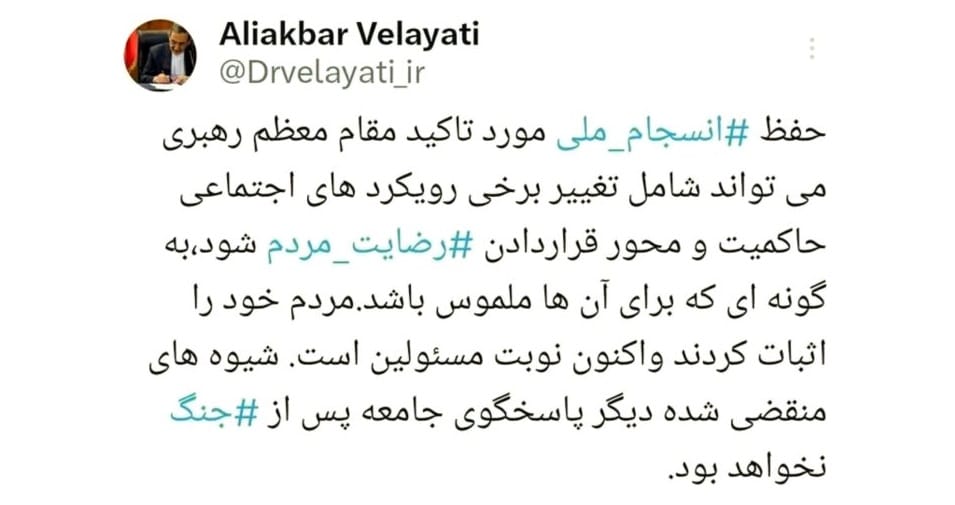
The so-called Moderate Factions of the Islamic Republic are a political patchwork quilt: Hāshimists [the followers of the late Ali Akbar Hashemi Rafsanjani, a former President and one of th founding fathers of the IRI], regime-loyal “reformists,” security officials critical of the so-called Axis of Resistance, Islamists with a taste for the West, party operatives from the Moderation and Development Party, the Union of Islamic Iran People Party, the National Trust Party, and the Executives of Construction of Iran Party; the “Donya-ye Eghtesad” newspaper circle and anti–state-economy technocrats; plus an assortment of opportunists cozy with the Supreme Leader, who drift between the “principlist camp” (hardliners) and the reformist faction depending on the political weather, figures like Ghalibaf, Velayati, Larijani, Zarghami, and their ilk.
This colorful spectrum broadly represents Iran’s domestic bourgeoisie and commercial classes. Their ultimate goal has always been the same: to preserve the Islamic Republic while steering it toward deeper integration into the global trading system and normalization with the West. Their operative paradigm is economic liberalism, not political liberalism. That’s why pledging allegiance to the Supreme Leader and maneuvering through power centers such as the Expediency Discernment Council’s Research Center has always been less risky for them than the messier business of civil society–driven activism.
Under the cabinets of Khatami, Rouhani, and now Pezeshkian, they have spoken of “national reconciliation,” but their reach rarely extended beyond reforms administered in homeopathic doses. The main levers of political power were never in their hands. The practical outcome of their policies was to deepen public disillusionment with “reform” itself and drive voters away from the ballot box.
Now, after Israel’s twelve-day military onslaught, they are openly talking about the need to change the “governance paradigm.” That paradigm, when stripped of euphemism, is the Supreme Leader’s doctrine of clerical rule (Velayat-e-Faghih) and the Shiite radicalism of the “Axis of Resistance.” Their first step, however, is not a constitutional overhaul but the symbolic adoption of middle-class lifestyle norms and a loosening of Internet censorship. The removal of firebrands like Kazem Seddiqi — Tehran’s Friday Prayer leader and head of the “Promotion of Virtue and Prevention of Vice” headquarters, one of the main hubs of Islamo-fascist zealotry — is meant to mark this shift. In a later phase, the purge might extend to hard-line jihadi commanders such as Saeed Jalili, the fiercely anti-American, anti-Israeli fundamentalist and current member of the Supreme National Security Council.
Fear of Collapse and the “Defense Council”
Twelve days of punishing Israeli strikes against the regime’s political and military apparatus drove home a sobering reality for the ruling elite: their vulnerability. And because this threat — unlike past domestic uprisings — descended from the skies and crossed the borders, the regime’s sacred go-to “solution” for self-preservation, namely more repression and bloodshed, proved useless.
The leadership knows that a large swath of an exhausted public quietly welcomed the Israeli attack, and even now would not mind seeing it continue. The “monarchist opposition” was reinvigorated, drawing closer together in unity. Talk of a coup became more serious. The most-watched Persian-language satellite channel threw all its resources into legitimizing the Israeli offensive and, likely, a coup by disgruntled officers, branding it as a rescue operation for Iran. With satellite broadcasts drawing audiences in the millions, and YouTube replays racking up over one or two hundred thousand views, the monarchists’ propaganda machine is holding its own in the battle for narrative supremacy.
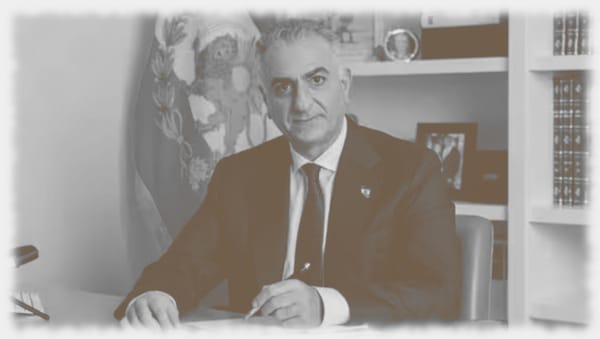
Here, Israel’s military prowess meshes seamlessly with the monarchists’ deep pockets, the Israeli lobby’s reach, and the carefully burnished image of the former crown prince, Reza Pahlavi, cast as the custodian of Iran’s lost “golden age” of middle-class prosperity, nostalgia weaponized, with a deft rewriting of historical memory. Together, these forces pose a greater existential threat to the Islamic Republic than at any time in recent decades.
In response, the regime has established a new “Defense Council” under the umbrella of the Supreme National Security Council — chaired by President Masoud Pezeshkian and comprising senior civilian and military officials — in an attempt to consolidate and fortify its defensive power. According to a reformist daily, “The creation of the Defense Council can be read as a clear sign of the redefinition of threats [the likelihood of renewed military attack and Israeli infiltration of Iran’s security and intelligence apparatus] and the reorganization of the power structure within the Islamic Republic” (Etemad, August 4, 2025).
Who Holds the Winning Hand?
The immediate beneficiary of Israel’s assault, in my view, is not the monarchist opposition at all, but the broad neoliberal bloc inside the Islamic Republic, those same Moderate Factions described above. For three decades, they have played the role of a compliant “quasi-opposition,” running the levers of Iran’s free-market economy, privatization drives, chambers of commerce, and the state bureaucracy, while being politically and militarily neutered enough to pose no real threat to the Revolutionary Guard or the Supreme Leader’s office. (For more detail, see: Abdee Kalantari, “The Power System and Shiite Theocracy.”)
After Israel’s and America’s military strikes, these Moderates caught the scent of Islamo-fascism’s approaching death and suddenly found their courage. They now speak boldly of the need to “change the governing paradigm.” They know there are receptive ears in the West, and that if they abandon uranium enrichment ambitions and anti-Israel hostility, the road to reconciliation will be wide open. From the standpoint of global capital — the European Union, Trump’s United States, the Arab states, India, East Asia — why gamble on a loud, high-risk Israeli coup when a quiet, creeping coup, cheaper and with better odds, might do the trick?
Why, in the competition among Iran’s bourgeois factions for the middle class approval and power, do the monarchists have the weaker hand? Part of the answer lies in the collapse of the “regime change” dream that was supposed to ride in on Israel’s bombing campaign. Recall that in coordinated timing with the Israeli attack, Reza Pahlavi flew to Paris, where in a multilingual press conference, he declared the regime “on the brink of collapse” and “at the edge of disintegration.” “This is a golden opportunity the world has given my compatriots,” he proclaimed.
Speaking about the bombing of Evin Prison, Pahlavi claimed it was a “symbolic” strike that opened the gates without harming prisoners, thereby toppling another pillar of the regime’s power.” The attack, he said, “is seen by the people as a positive act.” Asked again by another reporter, he repeated that hitting Evin “makes it even more possible for the people to strike the regime,” calling the bombing “encouraging” and “positive.” He even asserted, “Reliable reports indicate that [the Supreme Leader] Ali Khamenei’s family and the regime’s leaders are fleeing the country.”
And the result? After the regime’s retaliatory missile strikes on Israeli cities, Netanyahu and Trump declared a cease-fire. No masses flooded the streets to restore the monarchy; no sudden collapse of the regime followed the loss of a few top military and security chiefs. Contrary to the Paris press conference bravado, the twelve-day war ended with an awkward truth: even if many Iranians view Pahlavi favorably, they are not prepared to gamble their lives in street battles to bring him back.
The episode made one thing clear: the only plausible route for Pahlavi’s return to power is via an Israeli-American coup. He seemed to confirm as much soon after, announcing on X (formerly Twitter) through Iran International that he was opening formal recruitment for disaffected military, police, and intelligence officers: “I have created an official channel through which officials in the armed forces, security, and law enforcement can contact me and my team directly to join our expanding operations.”
Now, the monarchists’ domestic rival — ironically strengthened by Israel’s military intervention — finds itself in a better position. (On the middle class’s ambivalent view of monarchists versus reformists, see: Abdee Kalantari, “Peace with the Devil”; on the notion of an opposition coalition, see: Abdee Kalantari, “From the Center to the Right and Beyond.”)
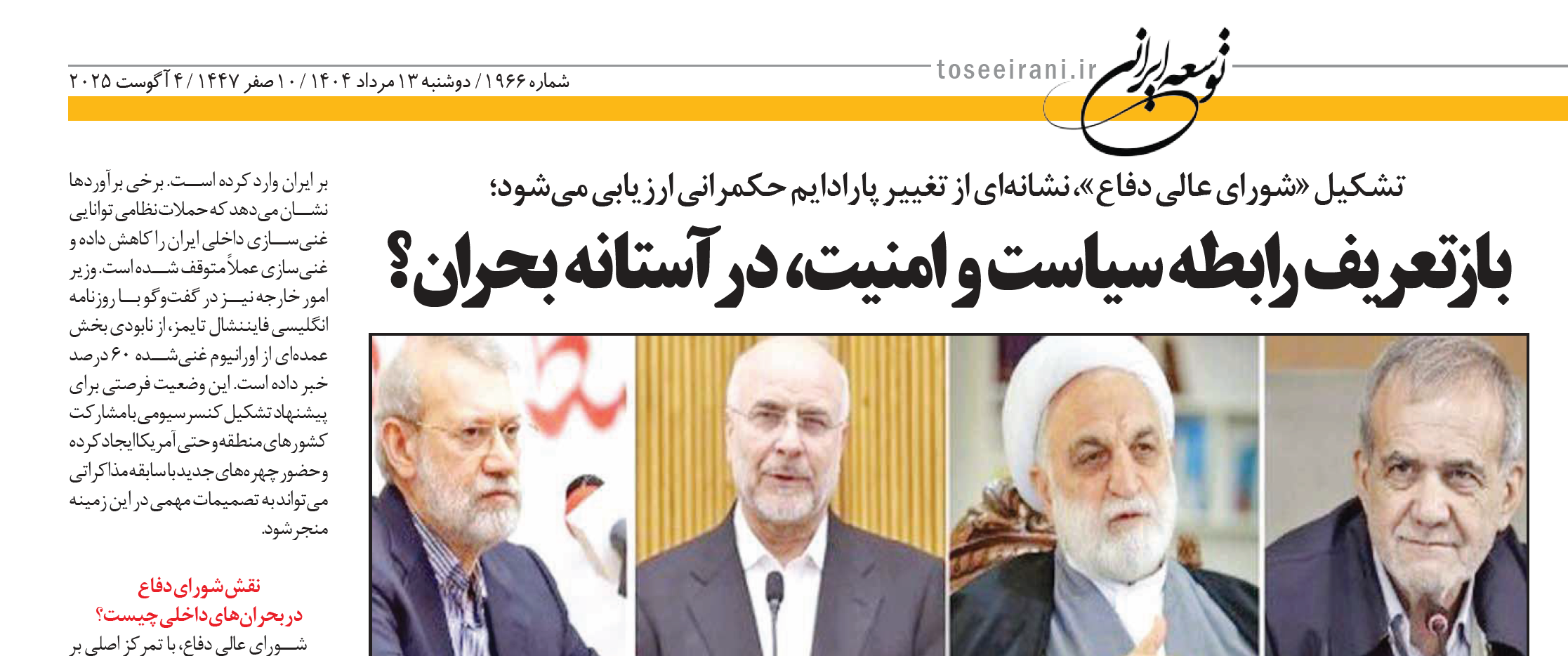
Economically, the Moderates’ “development” agenda is hardly different from the monarchists’. Socially, their program boils down to removing Internet filters and embracing middle-class lifestyles, especially for women and youth, including an end to mandatory hijab. If they succeed — and it is a big “if” — victory over both the regime’s internal Islamo-fascists and the monarchist opposition would amount to a low-cost coup of its own, what one might call “metamorphosis” or “paradigm change” in governance.
This was the promise blazoned across the front pages of papers like Sazandegi and Tose’e Irani on August 4, 2025.
— A.K.