Blood and Bones Besieged by Two Camps

Thursday 22 January 2026
Besiege your besiegement, no way out.
Your arms fell, pick them up.
Strike your enemy, no way out.
Mahmoud Darwish
From the moment we open our eyes, if we have slept at all, we coil inward like serpents, tightening with each new blow of bad news.
A second-generation Iranian who supports Palestine, in the middle of arguing against bringing Israeli flags to demonstrations in support of Iranian protesters, says: We are a nation of three or four thousand years. Why are you bringing the flag of a country less than a hundred years old? With all her internationalism, perhaps no other argument comes to her mind. Perhaps she has tried them all. I try to understand her.
A journalist bursts into laughter, saying Reza Pahlavi is a puppet of imperialism. She remembers how, when she was beaten at pro-Palestine demonstrations, the Pahlavists laughed at her. Now they themselves are being humiliated by British police after attacking the Iranian embassy in London to replace the flag there with their own, and she finds it proper to laugh at them. I try to understand her too, as she laughs at a time of our mourning.
I understand my neighbor, who did not wear a hijab in Germany but did in Jordan, where her home is. Her husband once asked me: Don’t you feel guilty that you’re here and encouraging people in Iran to go out into the streets to protest? I try to understand him as well. A liberal Muslim who preferred life in Germany over shoveling money in Saudi Arabia, yet—without knowing anything about my activism—judged me like that. We both listen to Aya Halaf.
I understand those who chant Long live the Shah. I understand those obsessed with numbers, who publish their truth-seeking calculations as if they have discovered something, as if all those human rights organizations, media fact-checkers, and survivors’ testimonies had never existed. I try to understand them too.
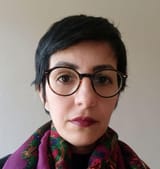
This image is the closest we have come to extracting justice for our martyrs. Hamid Nouri, a former deputy prosecutor at Gohardasht Prison, was sentenced to life imprisonment in Sweden for his role in the mass execution of Iranian political prisoners in 1988. His son was interviewed by Omid Montazeri—then a BBC journalist—whose own father, Hamid, was among those executed.
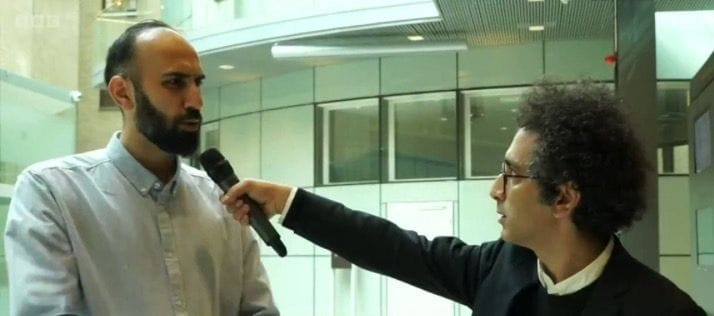
Nouri was later exchanged for two prisoners holding Swedish citizenship in Iran and returned home with a garland around his neck. Two thousand or thirty thousand dead—no justice has been extracted for any of the victims of 1988.
For the mother who writes, “I am Dorsa Sattar’s mother. I am the mother of Iran. I am the mother of Iran. They riddled my daughter with bullets. Tell the people of the world: I buried her in our yard; she is safe there. Soon, I will lie beside her myself”—the numbers do not matter much. She is the mother of them all.
For every hand we extend in solidarity, there is a condition.
To people who have come into the streets with promises of a final battle (and this is not all protesters), we say foreign intervention is disastrous and show them Iraq and Afghanistan as examples—while our chests are not the ones facing bullets, and while they cry for any help, any help at all to save them from this massacre. An intellectual says: don’t advocate for the voices of Iranians to reach non-Persian speakers. A woman academic who once shared that view now leaves no platform unused to speak about the protests she had been so sceptical about!
I ask a dear friend if we will hold our heads up again after all this bitterness.
But others will come. And they will rise again. People who remember that the soil in which you search for your loved ones’ bones under rubble was destroyed by a single global order. An order in which one right-wing, religious, misogynist government commits genocide amid global applause and sells weapons to Rwanda and Congo so people can be slaughtered on both sides, and another right-wing, religious, misogynist government massacres Syrians so Assad can stay a few more years and then move to another palace. The same order that replaces Assad with a murderer in a suit, sending forces to kill women fighters who once fought DAESH while the Kurds were abandoned to slaughter. For this order, our deaths are no more than collateral damage—one less life, one less potential for resistance.
“Death to the left” is chanted and echoed in many Iranian rallies these days. From Tel Aviv to Tehran, anyone advocating for international solidarity is cursed. Death is wished for those who died before this, in the summer of 1988 and during all years of occupation and colonization and the genocide that was livestreamed to us. The statue honoring the women Kurdish fighters who fought DAESH in al-Tabqa is toppled as the Syrian government forces take over the city. Living transnational solidarity is proving increasingly difficult in these times. But what other choice do we have to preserve life other than looking at each others’ pains and recognizing that it is only in this recognition that our solidarity won’t be conditioned when it comes to preserving lives from Gaza to Rojava, from Tehran to Kabul?
© Copyright IranDraft