Azadi Square and the Concert That Never Happened
In a country where poverty, corruption, water and power shortages, and runaway inflation are fueling unprecedented anger, the sight of a massive crowd gathered freely in the heart of Tehran could have done more than provide music; it could have lit the fuse of a street revolt.

September 5, 2025
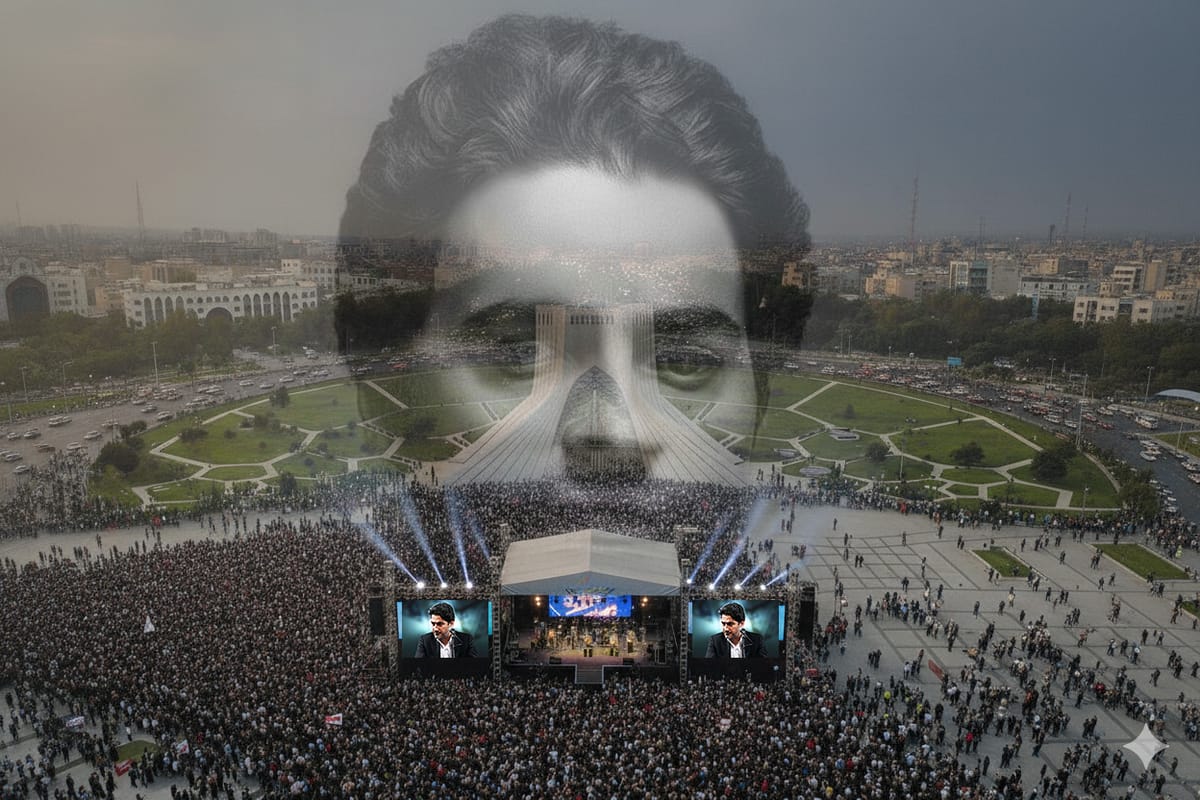
The announcement of a free Homayoun Shajarian concert in Tehran’s Azadi Square was like striking a match over dry brush: instantly, political speculation and media spin ignited. For the first time in years, the state had granted an official permit for a non-government concert. Shajarian — 50 years old, son of the late Mohammad-Reza Shajarian, the most revered vocalist in Persian music — is no radical. He’s a master of traditional (and recently some fusion music), long considered “safe” by the regime.
But less than forty-eight hours later, he told the public what everyone feared: the authorities had pulled the plug. Reformist newspapers splashed the cancellation across their front pages in bold type, lamenting it as yet another blow to “national reconciliation.”
The concert, slated for Friday night, September 5, 2025, at Azadi Square, could easily have drawn tens of thousands. And therein lay the danger. In a country where poverty, corruption, water and power shortages, and runaway inflation are fueling unprecedented anger, the sight of a massive crowd gathered freely in the heart of Tehran could have done more than provide music; it could have lit the fuse of a street revolt.
Reformists saw the event as a propaganda gift, a chance to peddle their tired line about “reviving joy and hope” to reconcile a disillusioned people with the state. Hardliners, however, remembered history all too well. In October 1977, just a year before the Islamic Revolution toppled the Shah, Tehran’s Goethe Institute hosted the famous “Ten Nights of Poetry.” Supposed to be harmless literary evenings, they quickly morphed into a staging ground for political dissent, each night swelling with bolder student voices until a ten-thousand-strong protest erupted, one of the sparks of the 1979 revolution. The Islamic Republic knows that history. And it knows the danger of tens of thousands of disgruntled citizens converging in one public square.
Reformist daily Ham-Mihan ran an editorial claiming the opposition to the concert came from “two wings” — regime hardliners on the one side, and “foreign-backed” exiles on the other. Both, the paper argued, shared a hostility to “the people” and to their right to gather in public. Then the editorial cut to the core: the issue wasn’t music, or hijab, or morality. The problem was the street itself.
Exactly. The street, the public square, is where real politics happens. And that’s precisely what terrified the authorities. Because while the editorialist naively insisted that a massive public gathering would demonstrate “the unity and defensive strength of the nation” against foreign enemies, the more obvious possibility loomed: that such a gathering could just as easily turn into a massive protest against the Islamic Republic itself.
That, and nothing else, is why the concert never happened.
Veteran journalist Faraj Sarkouhi offered the wisest caution just before the cancellation: don’t rush to pin a fixed political meaning on such events. Wait and see what reality produces. The sheer presence of thousands in a central public square contains infinite possibilities. It can tilt toward state propaganda, or it can explode into a popular uprising. The regime knows this, which is why it crushed the concert before a single note could be sung. /// A.K.
Faraj Sarkouhi offered the wisest caution just before the cancellation.