The Story of a Structural Corruption
What did bring Ayandeh Bank to its knees? How did a supposedly modern private bank accumulate a deficit so vast, 550 trillion tomans in losses, that the Central Bank could no longer look away?

Friday, October 24, 2025
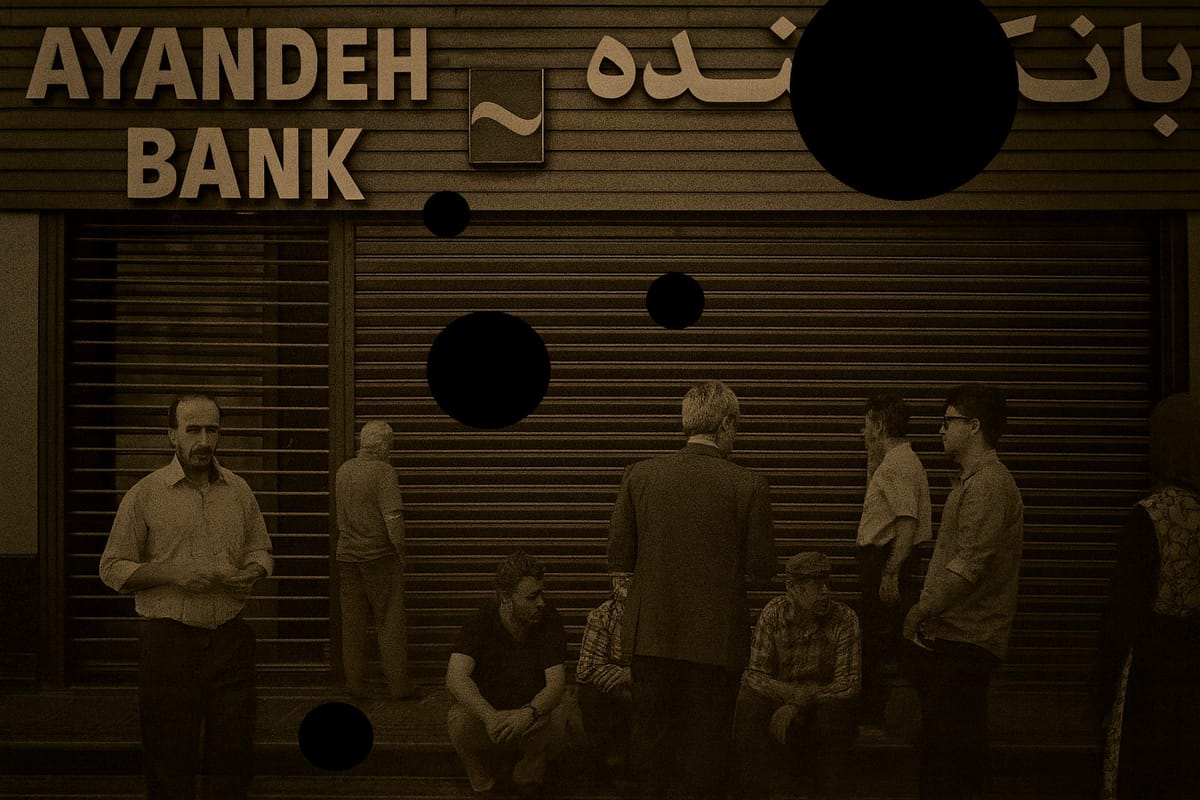
Two days ago, on Wednesday, October 22, the Central Bank of Iran formally dissolved Ayandeh Bank, the country’s most controversial private financial institution. The legal term for this act was a “resolution process” (فرایند گزیر), a bureaucratic prelude to liquidation. The bank’s branches are to be transferred to Bank Melli Iran, so that depositors and account holders will henceforth deal with that state institution instead.
But what brought Ayandeh Bank to its knees? How did a supposedly modern private bank accumulate a deficit so vast, 550 trillion tomans in losses, that the Central Bank could no longer look away?
The Mirage of Private Banking
Private banking in the Islamic Republic has, since its inception, grown in the shadows: opaque, patronage-driven, and often mafia-like. Thanks to connections, most private banks enjoyed exemptions from real oversight. It was as if the entire policy of “private banking” had been engineered to serve as a convenient conduit for the powerful, an institutional façade behind which enormous loans could be extended to insiders, never to be repaid, all under the banner of “development.”
Ayandeh was one such conduit. Year after year, it widened its deficit through projects that inflated rather than produced wealth. By the end of 2024, its accumulated losses had reached roughly 465 trillion tomans.
According to the Central Bank’s director of banking supervision, Hamidreza Ghani-Abadi, more than 90 percent of Ayandeh’s loans had gone to its own affiliates and to subsidiary megaprojects such as Iran Mall, Farmanieh Mall, Mashhad Mall, and the Rotana Hotel. Neither of these loans was repaid. The assets themselves, mostly concrete monuments to vanity, were so illiquid that turning them into cash was practically impossible.
The Empire of Glass and Debt
Among Ayandeh’s subsidiaries, Iran Mall was the leviathan: a glass-and-marble behemoth that devoured depositors’ money like a black hole. Conceived as a symbol of “national pride,” it became instead a monument to systemic plunder. From 2011 onward, the mall was built with direct financing from Ayandeh. According to official documents, the bank alone funneled more than 74 trillion tomans into this project, none of which was ever recovered.
In Central Bank reports, Iran Mall now appears as a “frozen and loss-generating asset.” Independent sources reveal that between 2015 and 2017, over 35 trillion tomans in phantom loans were granted to the Iran Mall Development Company, later “settled” through sham stock transfers and paper-company transactions, so that the balance sheet might appear deceptively sound.
A House Built on Sand
Even semi-official outlets could no longer conceal the rot. As Ghani-Abadi later admitted, Ayandeh, from its very birth, had used depositors’ funds not for public lending but to feed a closed circle of its own shareholders and affiliated entities. No real repayment occurred, yet interest payments to depositors had to continue each month. To pay those, the bank lured new depositors with higher returns, a textbook Ponzi scheme.
Like a casino run by a polite mafia, Ayandeh promised yields far above the market rate, between 24 and 27 percent, while the Central Bank’s ceiling was 18. The aim was simple: attract new money to pay off old obligations, while simultaneously draining liquidity from other banks.
The model was not new. The most infamous “banking Ponzi” in modern history was that of Bernard Madoff, the Wall Street icon who defrauded investors of an estimated $64.8 billion before his empire collapsed in the 2008 financial crisis. Madoff, too, paid early investors with the funds of later ones and forged accounting statements to sustain the illusion of profit, until a wave of withdrawals exposed the void. In 2009, he was sentenced to 150 years in prison for securities fraud and money laundering.
Iran’s version had no courtroom drama, only the quiet sealing of vaults.
The Anatomy of a Collapse
By the time regulators finally intervened, Ayandeh Bank’s capital adequacy ratio had sunk to minus 350 percent, a formal declaration of bankruptcy by any international standard. Almost 98 percent of its large-scale loans were non-performing, a glaring testament to the structural rot in its lending practices. Over 60 percent of the bank’s assets were “frozen,” meaning they produced no income and could not be liquidated. The balance sheet had ossified; the institution could no longer move.
Between 2023 and 2024, Ayandeh was losing an average of 360 billion toman per day. Its liquidity gap was so vast that it repeatedly overdrew from the Central Bank, totaling more than 500 trillion tomans, roughly a third of all overdrafts in Iran’s banking system. Those overdrafts, in turn, swelled the monetary base and stoked inflation.
The government now insists that dissolving Ayandeh will ease pressure on the Central Bank’s reserves and slow liquidity growth. Perhaps it will. Yet everyone knows that Ayandeh was not an isolated case but the visible tip of a deeper malaise. Other loss-making banks, protected by political patrons and opaque “development projects,” continue to circulate money in the same closed loops of privilege and impunity.
A Mirror to the System
What collapsed, then, was not merely a bank; it was a model. Ayandeh’s demise revealed the internal logic of Iran’s privatized-in-name-only banking system: a structure designed not to create productive investment but to convert political proximity into private gain. Each skyscraper and mall erected with depositors’ money stands as a monument to this inversion of purpose.
For years, the façade glittered, gleaming malls, luxury hotels, and slogans of “national pride.” Behind the façade lay an arithmetic that could never add up. When the curtain finally fell, it exposed the anatomy of systemic corruption: a state that licenses private banks, those banks that finance their own empires, and regulators who intervene only after the damage is done.
In the end, Ayandeh’s story is not one of sudden catastrophe but of slow-motion implosion, a pyramid of promises collapsing under its own weight. Its downfall may lighten the Central Bank’s burden for a while, but the structure that produced it remains intact, waiting for the next inevitable reckoning.
— A.K.