Beyond the Mountain Myth: Kurdistan as Society
Kurdistan is often reduced to a militarized myth, erasing society, class, and everyday life. This essay argues for restoring social reality at the center, showing how both internal politics and external narratives flatten complexity across Kurdistan and Iran.


I wrote this article because I noticed a recurring pattern in Western and Persian-language media: instead of depicting Kurdistan as a real society, coverage produces a political image that distorts its complexity. My main argument is that this misrepresentation prevents genuine understanding of Kurdistan as a living, evolving society.
Within this frame, Kurdistan does not appear as a living society with cities, classes, institutions, generations, tensions, and contradictions. Instead, it appears as something easily consumed: mountains, guns, flags, a handful of military organizations, and an abstract horizon that is supposed to either liberate all of Iran, break it apart, or tie it to one of the region’s existing geopolitical projects.
In this image, the Kurd becomes a single body, fully visible only when understood in relation to war, borders, intervention, alliances, or shifting regional balances of power. Over the past month, this kind of representation has reached its peak. But which Kurdistan are these media outlets talking about? Which Kurd? Which social life?
This cannot be reduced to a few media mistakes, to the crude romanticism of some European journalists and writers, or to activist fantasies. What we are dealing with is an entire way of seeing, one that turns Kurdistan, at once, into an object of resistance and a strategic asset. The result is that a complex social field of millions of people is reduced to a symbolic reserve for regional politics. This image does not emerge from the real complexity of society. It is produced through selection, erasure, and compression.
This article critiques the reductionist image that shrinks Kurdistan into a purely military and geopolitical landscape. The argument is not simply that pan-Iranists, the West, Israel, war media, or security analysts have misunderstood the Kurds. Rather, it asks why this image is so readily consumed, why it circulates so easily, is reproduced so often, and is sometimes reinforced by Kurdish political forces themselves. The problem is not only one of external imposition; this representation is also rooted in specific political traditions.
The Mountain as a Machine of Erasure
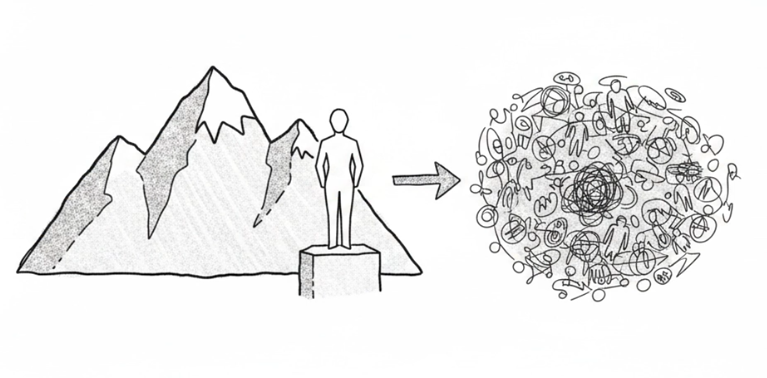
To understand this process more clearly, we have to move beyond seeing the mountain as merely a geographic, cultural, or poetic idea. In the dominant representation, the mountain functions as an entire way of seeing. It operates as a mechanism that pushes the quieter, slower, more complex, and more contradictory aspects of social life out of the frame, replacing them with a tighter, more mythical image, one that is far easier to consume politically.
In this sense, the mountain erases many others and, in their place, produces an imaginary substitute subject: masculine, military, disciplined, identity-driven, and ready to fit neatly into war reporting, security analysis, liberal fantasy, or party propaganda.
The first result of this mechanism is the erasure of the city. And yet a large part of life in Iranian Kurdistan is shaped in cities: in universities, markets, schools, neighborhoods, workplaces, professional networks, and in the contradictory experience of urban life itself. Sanandaj, Mahabad, Marivan, Kermanshah, Saqqez, Bukan, and other Kurdish cities are not merely symbolic backdrops for a military or identity-based horizon. They are real centers where social politics is produced.
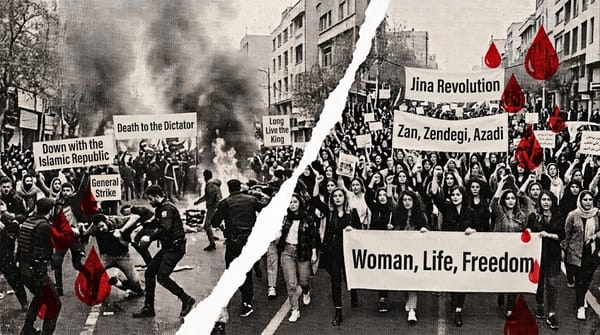
But in the dominant image, the city is displaced from being a living political space and pushed to the margins. It is noticed only when a general strike disrupts the political balance for a few hours, or when its streets become sites of confrontation. Otherwise, the Kurdistan this gaze prefers is not an urban society at all, but a mountainous border landscape.
The second layer is the erasure of labor and class. In this frame, the fighter replaces the worker. And with the worker disappear the teacher, the driver, the nurse, the unemployed, the low-ranking employee, the kolbar, the student, the street vendor, and the women whose lives are embedded in the everyday work of social reproduction. Questions of capital, labor, poverty, exploitation, unemployment, privatization, subcontracting, and the slow erosion of daily life are pushed aside. A society that should be understood through its social contradictions is once again rearranged as a warrior nation. This is not an accidental omission. Erasing class is necessary if a deeply uneven society is to be turned into a single unified body that others can speak for.
The third layer is the erasure of everyday life. Every society takes shape through habits, fears, hopes, conservatisms, family relations, the desire to survive, quiet forms of resistance, and the small but material decisions people make. Politics is not formed only in intense, dramatic moments. It is also made in schools and hospitals, in markets and bread lines, in taxis and factories, in dormitories and homes, and in the informal networks of daily life. The mountain narrative has no patience for these layers, because they do not fit the logic of myth and visual mobilization. They are slow, contradictory, irregular, full of retreats and advances. But this is precisely where real politics is born.
The fourth layer is the erasure of contradiction itself. The mountain image tends to present Kurdistan as a single, homogeneous collective subject, even though no society is ever that pure. Kurdistan, too, is shaped by class divisions, generational differences, the gap between urban and rural experience, conservative religious layers, processes of secularization, migration, political exhaustion, and differing horizons of action. An image that sees only the fighter, the weapon, and the slogan strips society of its living core, which is its heterogeneity and contradiction. This gaze, whether in its Orientalist form or its nationalist one, arrives at the same conclusion: society must be simplified in order to be made consumable.
In that sense, the mountain is less a place than a technology for filtering reality. Anything that does not help build the myth is pushed out of sight. What emerges is not a Kurdistan that can be understood as a society, but a Kurdistan already prepared in advance for political use.
More Than an External Misreading
But this representation has not been imposed only from the outside. If that were the case, it would be easier to criticize. The real issue is that part of this image has also taken shape within certain political traditions inside Kurdistan itself.
In one current of Kurdish nationalism, which we can broadly describe as peshmerga (guerrilla)-centered, armed struggle gradually ceases to be an extension of social politics and begins to take on a self-contained logic of its own. In this tradition, armed force is no longer just one form of struggle. It becomes the highest form. As a result, political and social struggle is either pushed to the margins or made meaningful only in relation to military action.
At this point, one important distinction must remain clear. Kurdish nationalism cannot be understood through the same logic as dominant, state-based nationalisms, whether in their Turkish or Arab forms or in classic European models. It emerged in the context of a people who were divided, denied, and oppressed, and in many historical moments it has functioned less as a language of domination than as one of survival, the defense of collective dignity, and the demand for political and cultural equality.
For that reason, simply invoking Kurdish nationalism does not automatically carry a negative meaning. The problem begins when this defensive horizon starts to take the place of society itself, when the nation is substituted for a contradictory social reality, when class and gender divisions are covered over, and when social politics is absorbed into the logic of identity, organization, and military discipline.
At that point, society no longer appears as a living subject with multiple ways of life and organization. It is reduced instead to a support environment, a rear front, or a source of logistics and legitimacy. The city gives way to the village and the border. Civil organizations become secondary to the armed ranks. Politics, instead of expanding through schools and universities, factories, neighborhoods, professional associations, or civil institutions, becomes trapped in the cycle of war, ceasefire, negotiation, and return to war.
The peshmerga is no longer just one part of a broader social movement. By separating itself from the social body, it becomes the symbol of the movement as a whole. People are transformed from agents who organize their own society and enter politics into those expected to support an armed force increasingly detached from everyday social life.
Not every form of nationalism is the same, and not every form of collective defense against national oppression should be conflated with dominant chauvinism. The issue is that nationalism, even in its oppressed form, tends to shift once it moves beyond demands for equality and the removal of discrimination and becomes the main horizon of politics. At that point, it begins to place the nation in the position of society, to cover over class contradictions, and to construct a single unified “we” in which worker and employer, woman and man, conservative and secular, urban and rural, are compressed under the name of the nation. This is precisely where nationalism, even when grounded in the real wound of oppression, begins to move away from the horizon of emancipation and runs up against its own structural limits.
In such a context, external representation is no longer simply a misunderstanding. It becomes the condensed form of an earlier erasure that had already begun within certain political traditions themselves. Once parts of political practice have already pushed society to the margins and elevated the gun as the primary measure of legitimacy, war media and geopolitical analysts are more than ready to reproduce that same erasure on a larger scale.
When Armed Struggle Becomes a Cult
A clear distinction has to be made here. This is not an argument for the outright rejection of armed struggle. Neither history nor politics would support such a claim. In West Asia, at many critical moments, different forms of armed resistance have been part of reality, and they will most likely remain so. In the Kurdish experience, too, the mountain, the border, and the gun are part of history. But the problem begins when armed struggle moves out of its place and turns into a cult.
The cult of armed struggle takes shape when the gun becomes the highest measure of radicalism. In that situation, anyone who insists on social, political, economic, urban, and mass struggle is accused of abandoning struggle altogether. Once armed force comes to represent the entire existence of a movement, civilian organizations become secondary. Urban activists, instead of building a social base in their own workplaces and communities, are drawn toward the armed ranks. Moving into military work is no longer treated as a specific and limited task, but as a natural step up to a higher level of struggle. The result is that the city is emptied of cadres, social organization wears down, and political struggle itself is pushed to the margins.
This is not just a moral or tactical deviation. It is tied to the material and organizational logic of this kind of tradition. Real society is difficult. Urban society moves slowly, it does not simply obey orders, it is full of contradictions, it cannot be directed from a single center, and it constantly forces an organization to confront real demands, retreats, doubts, and the uneven rhythms of people’s lives. By contrast, military and border logics produce structures of power that are tighter, more centralized, and easier to control. Within that logic, crisis and war are not only threats, they are also opportunities. The breakdown of security, the disruption of ordinary life, and the growing centrality of military questions make it possible for forces with a limited social base but stronger military and media capacity to gain political weight far greater than their actual influence within society.
That is why criticizing the cult of armed struggle is not just about criticizing a single bad choice. It is a critique of an entire political formation in which the organization takes the place of the people, and geopolitics displaces social politics.
Iranian Kurdistan and a Different Political Horizon
What makes Iranian Kurdistan important is that this trend was never without rivals there. By Iranian Kurdistan, I do not simply mean the provincial geography defined by the state, but the Kurdish population living in western and northwestern Iran, deeply woven into the country’s social, class, and political developments. Iranian Kurdistan became the ground for an important political formation that sought to understand the Kurdish question not through peshmerga romanticism, but through social change, the city, class, and mass politics.
Within this horizon, the question was not simply how to represent a collective identity through armed force. The real question was how, in the context of expanding capitalist relations, growing urbanization, rising wage labor, and deepening class divisions, national oppression could be connected to a broader struggle over social and political power. In this framework, Kurdistan was not seen as an exception standing outside the wider history of Iran, but as part of a society undergoing transformation. The city was the center of gravity of politics. If ending national oppression meant anything, it had to pass through its connection to economic demands, political freedoms, social organization, and struggle against class domination. Armed struggle, if it existed at all, could not replace this horizon. It had to be defined in relation to it.
This is precisely where this horizon differed from the peshmerga-centered tradition. In that tradition, armed struggle becomes the movement itself. Instead of politics taking shape through the people, through organizations, strikes, economic protests, and mass action, armed force gradually separates from society and rises above it. But in Iranian Kurdistan, history was never only the history of armed organizations. It was also the history of general strikes, urban politics, mass intervention, and sustained efforts to connect national oppression with class contradiction.
That tradition, although repeatedly pushed back under the heavy pressure of the Islamic Republic’s repression—executions, militarization, the destruction of political space, and the dismantling of organizations—never completely disappeared.
That is why the end of armed struggle in Iranian Kurdistan during the 1990s cannot be explained only in terms of military defeat or shifts in the regional balance of power. It also had to do with society itself: the growth of urban life, class transformations, the exhaustion produced by war, changing forms of everyday life, and the fact that Kurdish society, even under severe repression, did not accept that an armed force should take the place of society itself. The romantic image of armed struggle persisted in parts of the collective memory, but over time it gave way to the realities of social life and to forms of struggle better suited to them. This process was not linear, clean, or free of contradiction, but it was real.
The tradition of general strikes in Kurdistan, rare in Iran, emerges from this very history. It shows that politics in Kurdistan has been produced in the city, in the market, in the workplace, in the school, and in the living relationships among people themselves. It was this same tradition that, after the Woman, Life, Freedom movement, opened up a horizon that extended beyond Kurdistan and suggested a broader possibility for Iran. Any narrative that explains Iranian Kurdistan only through mountains, guns, and its possible role as an ally of one or another regional axis erases not only today’s society, but its real political history as well.
Partitioned Kurdistan, Flattened Kurdistan
One of the most important features of the dominant representation is the way it flattens the four parts of Kurdistan into a single whole. This division across four countries was imposed historically, and it remains deeply painful. But any serious engagement with the Kurdish question also has to confront the historical and social reality of that situation.
Bashur, Rojava, Bakur, and Rojhelat each have very different historical, social, and political trajectories. Even these names themselves do not carry the same meaning for many people living in those areas, and in practice they are not always used, or at least not recognized in the same way.
These terms belong more to the horizon of Kurdish nationalism and to the Orientalist romanticism that often accompanies it. I use them here only to show the internal contradictions of that very logic and the role it plays in producing a false sense of uniformity.
Bashur cannot be understood without its party structures, oil rents, quasi-state logic, tribal and local power relations, and its place within Iraq’s political order. Rojava was shaped by the Syrian civil war, the collapse of state authority in parts of the north, siege, foreign intervention, and the formation of a specific political project in the midst of regional chaos. Bakur cannot be explained without the city, municipalities, electoral politics, the Turkish state’s systematic repression, and the complex link between the national question and mass politics. Rojhelat, meanwhile, can only be understood in the context of the Constitutional Revolution, the experience of the 1979 revolution, urban growth, the particular relationship between national oppression and class politics, and its connection to Iran-wide movements.
Even from a linguistic point of view, the artificiality of this flattening becomes clear.
People living across these four geographies often cannot communicate with one another directly or easily. Of course, they are all Kurdish, and they speak Kurdish languages, but from east to west and from north to south, from one city to another, there is a wide range of significant linguistic differences. The Kurdish language family, from Sorani and Kurmanji to Kalhori, Badini, and Zazaki, contains divisions and distinctions that themselves reveal how far the supposedly homogeneous whole of political and media representation is from historical and social reality.
The issue is not simply that these four parts differ from one another. The issue is that, at the level of geopolitical representation, the features selected and highlighted from each are precisely those that can be fitted into a large, simplified, and politically consumable image.
What gets emphasized across these very different experiences is not the real society or the distinct ways of life in each case, but a repeated set of representable elements: the mountain, the armed force, the flag, the stateless nation, the woman fighter, and parties or organizations ready to align with one regional or global pole or another. Different societies are thus turned into a single object.
The Parties That Help Reproduce the Image
At this point, we have to move beyond external criticism and examine the internal logic of certain political forces. These forces are not simply victims of representation. In many cases, they are actively involved in producing and stabilizing it. For some of these parties, the mountainous, militarized image fits their logic of survival and legitimacy better than real society does. This fit is not accidental. Real society is messy. Urban society does not follow simple commands. Class, gender, generation, religion, lifestyle, consumption, education, migration, and differing horizons of action all intersect and clash, forcing any organization to move beyond identity slogans and confront real complexity.
But military and border logics produce something else: a structure of power that is compressed, centralized, hierarchical, and easier to control. Within this logic, crisis and war are not merely exceptional moments. They are sources of political weight. A force with weak roots in society may still, through military capacity, media reach, and the ability to connect with outside actors, present itself as far larger than its actual social base. The specific experience of the camp, the mountain, organizational discipline, and the horizon of war is then presented in the name of the nation. The organization is treated as if it were society itself. Satellite forces or dependent networks are introduced as the natural voice of the people. Anything in the city that does not fit this image is either dismissed as unimportant or pushed aside with labels such as assimilated, deviant, or traitorous.
Alignment with the external gaze, then, is not simply accidental. When a party or political current defines itself primarily through the mountain, the gun, hostility to the central state, and its ability to link up with foreign powers, it becomes naturally more legible and attractive to war journalists, geopolitical analysts, regional strategists, and even segments of Western activism that no longer see their own societies as fields of change, than to the society in which it is supposed to take root. The image is produced precisely through this overlap.
The Lie of the “Kurdish Role” in the War
A clear example of this political fabrication could be seen in U.S. propaganda, and in media narratives aligned with it, about the “role of the Kurds” in the U.S./Israel war against Iran. In that image, Iranian Kurdistan was portrayed as a ready-made, compact force that could be directed from outside, as if all it would take were a foreign decision for “the Kurds” to suddenly become the ground force of an American scenario. But this image was not only politically false. It was also socially and materially absurd.
In western Iran, we are dealing with a large and complex society of millions, not with a laboratory project. From West Azerbaijan to Kurdistan and Kermanshah provinces, the region is already under a heavy military presence, from major army divisions to provincial IRGC structures and key operational headquarters. At that scale, even armed parties and organizations with a long history cannot simply enter a war scenario and imagine they can manage it in a controlled way.
We are not dealing with forces numbering in the hundreds, or even, in the most optimistic view, the low thousands of peshmerga, equipped with heavy logistics, air cover, and stable supply lines. We are talking, at most, about a few hundred peshmerga facing multiple heavily equipped divisions with tens of thousands of soldiers, armored units, artillery, intelligence networks, and regional backing. The gap is not symbolic. It is material, military, and overwhelming.
And then there is the fantasy layered on top of that: the idea that the moment an armed advance begins, ordinary citizens will suddenly pour into the streets and, like a dark mass in a cinematic war epic, “liberate Kurdistan” through sheer historical will. That is not strategy. It is wishful thinking dressed up as politics. A society under bombardment, surveillance, exhaustion, and layered fear does not automatically transform into a ready-made insurrectionary force simply because someone wants the script to move in that direction.
This kind of imagination substitutes spectacle for analysis. It erases the actual balance of forces, the unevenness of society, the cost to civilians, and the brutal asymmetry between lightly organized armed actors and a state or regional military machine. It confuses desire with capacity, and in politics, especially in war, that confusion can become catastrophic.
The point of this fantasy was not simply to invent a false military image of Kurdistan. It was to break the social imagination of change in Iran itself. The very people who, through the Woman, Life, Freedom movement, had opened one of the most progressive and emancipatory horizons in the world had to be pushed out of the frame, so they could be replaced by the familiar script of intervention, borders, proxy forces, and war.
In that sense, the U.S./Israeli narrative about the “role of the Kurds” was a despicable propaganda device and a colonial fantasy: a compressed, militarized image designed to erase society and recast Kurdistan as a ready-made instrument for geopolitical use.
Iran, Too, Is Denied as a Society
This whole discussion is not only about Kurdistan. Reducing Kurdistan to a geopolitical fragment is part of a broader inability to understand Iran as a society. Iran is not erased only in the Orientalist gaze of the West, nor only in the fantasies of parts of the opposition. Above all, it has been subjected to a ruling system that, for more than four decades, has worked to reduce society from a living political reality into a silent, scattered, and manageable mass.
In that sense, Iran has not simply been misunderstood. It has also been systematically stripped of the ability to represent itself. For decades, the Islamic Republic has tried to ensure that anything emerging from below, from within society, and independently of the state is either destroyed or absorbed into the language of the regime. Independent labor organizing, women’s movements, student bodies, civil networks, free media, local initiatives, and even the simplest forms of horizontal connection between people have faced constant pressure, surveillance, infiltration, closure, and punishment.
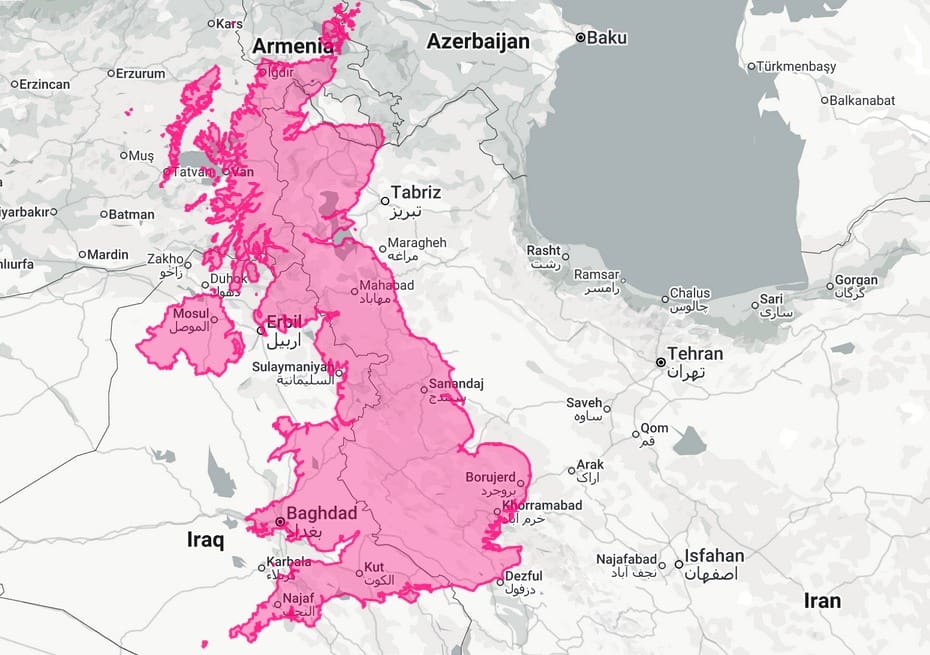
This is the context in which the external gaze comes to see Iran in limited, incomplete, and often clichéd ways. In much of Western media, and even in many Persian-language narratives, Iran is reduced either to Tehran or, at best, to a few large and familiar cities. It is as if a country of nearly 90 million people, with more than 1,400 cities and a vast range of linguistic, ethnic, religious, class, climatic, and historical differences, could be compressed into a handful of repeated images.
This reduction does not arise only from lack of knowledge or lazy media habits. It is also a product of the Islamic Republic itself, which, through sustained repression, has denied society the chance to appear publicly and visibly. The more organizations are crushed, the more provinces and cities beyond the center are kept in silence, and the more people are seen only in moments of upheaval or repression, the more the image of Iran becomes trapped within a few centralized and incomplete frames.
Within this frame, Iran is reduced less to a diverse and living society than to a political capital with a few provincial footnotes. The Islamic Republic has effectively policed the geography of visibility. It has not only determined who is allowed to speak, but also which parts of society can enter the frame and which must remain in the dark. The Iran that appears in many narratives is therefore an incomplete one, shaped both by an external, centralized gaze and by internal repression and the systematic silencing of voices by the state.
From this perspective, Kurdistan is only one of the places where this failure becomes more visible. It carries the national question, it has long been a site of the Islamic Republic’s repression and militarization, it is a field of competition among parties and states, and it is also a place where society is compressed into a ready-made image.
But if we see Kurdistan only through the frame of mountains, guns, and geopolitics, then we understand nothing about Iran itself. The same state that has kept Kurdistan under pressure through repression, securitization, and the destruction of social organizing has also acted, on a national scale, against the possibility of Iranian society appearing as society. The same gaze that reduces Kurdistan to the mountain reduces Iran to Tehran and a few familiar images. In both cases, what disappears is a society that, under constant pressure, remains alive, continues to resist, and is far more complex than these ready-made frames allow.
Bringing Society Back to the Center
If we want a more honest and analytical picture of Kurdistan and Iran, it is not enough simply to add a few missing elements back into the frame. The issue is not just correcting the image. The real task is to shift the center of analysis. Society has to be brought back to the center: with its cities, the growth of capitalism and wage labor, its classes and divisions, its women in the midst of everyday life, its youth, its schools and universities, its markets and workplaces, its exhaustion and resistance, its conservatisms and advances, its civil and professional forms of organization, and the complex relationship between national oppression, class contradiction, and the struggle for political freedoms.
This also means distinguishing between armed struggle as one possible form of political action and the substitution of society with it. The first may be real and necessary at certain moments. The second not only erases society, but also weakens the very possibility of emancipatory politics. Whenever armed force takes the place of society, the organization takes the place of the people, geopolitics displaces social politics, and the abstract nation replaces the living contradictions of real human beings.
Bringing society back to the center is just as vital for Iran. As long as Iran is seen only through security crises, regime-change scenarios, and its geopolitical fragments, neither serious politics nor real understanding is possible. Society must again be understood as the main field of contradiction, resistance, exhaustion, organization, and future possibility. The point is not to produce a more positive or sympathetic image of the Kurds. It is to defend the right of a society to its complexity, its contradictions, and its refusal to play the roles written for it by war media, regional strategy, or power-driven parties.
And perhaps this is the most important point of all: Kurdistan cannot be understood by erasing the city, erasing class, erasing everyday life, and erasing contradiction. In the same way, Iran cannot be understood through ready-made scenarios, geopolitical fantasies, or by replacing people with organization and power. Any politics that does not begin from real society will, sooner or later, slide either into geopolitics, party paternalism, or nationalism. Against all three, the only serious point of departure is society itself: people, in all their difficulty, heterogeneity, exhaustion, endurance, and reality.
One point needs to be stated clearly. The political and social traditions discussed in this text did not emerge out of nowhere, nor were they formed outside the history of Kurdish parties in Kurdistan. On the contrary, some were shaped precisely through the decades-long presence, influence, sacrifices, and social roots of these very parties within Kurdish society. For many people in Kurdistan, these parties were never just the names of a few organizations or forces based near the border. Their traces exist in family memory, in the experience of prison, execution, and exile, and in the lived history of a large part of society.
The critique in this article, therefore, is not aimed at denying this social connection or erasing the historical place of these parties. The issue is the image still being produced of Kurdistan, an image that reduces a living and costly social history to a few compressed and consumable signs. When Kurdistan is seen only through guns, camps, mountains, or a handful of organized forces, even the real and deep relationship between parties and society becomes distorted. What disappears is not only the complexity of society, but also the human and historical ground that gave these forces their meaning.
© Copyright IranDraft
We are dedicated to looking beyond headlines.
We bring the full story and context to you when it comes to news from Iran.