The Jina Movement and the January 2026 Protests: Continuity or Contradiction?

An interview with Elham Hoominfar
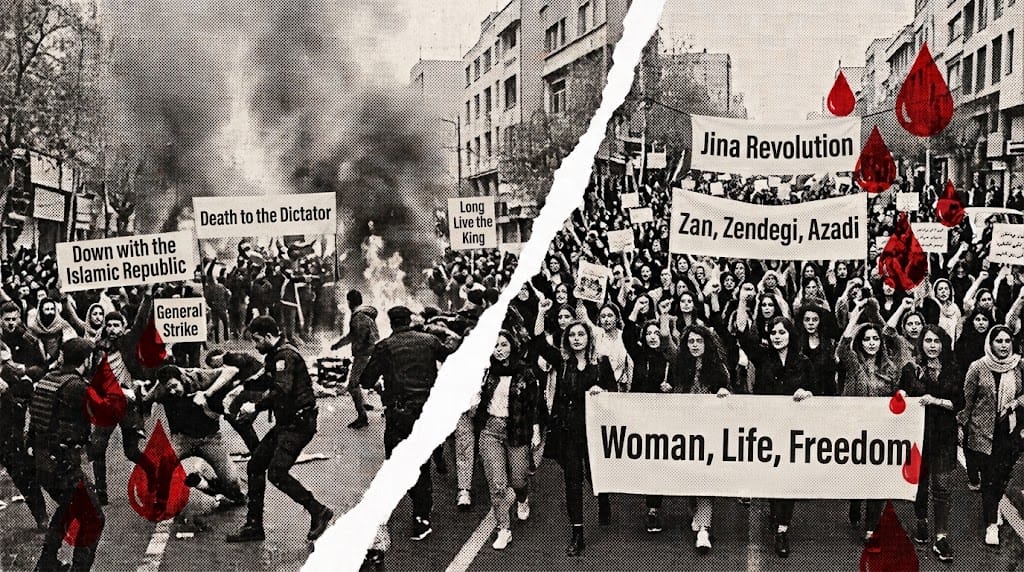
To mark the fourth anniversary of the “Woman, Life, Freedom” movement (2022), also known as the Jina Revolution after Jina Mahsa Amini, we spoke with sociologist Elham Hoominfar about that movement and the mass protests and bloodshed of January 2026, which took place during the Persian calendar month of Dey 1404. We discussed the continuities and tensions between these two uprisings.
Hoominfar’s observations about the distinctive character of the January protests are particularly important. Much of the conversation focuses on the lessons a sociological assessment of these two major uprisings may offer for the future.
This interview was originally published in Persian by IranDraft Farsi.
Two Uprisings and Their Internal Connection
In an interview marking the first anniversary of the Jina movement, or the “Woman, Life, Freedom” movement, published by Radio Zamaneh, you argued that the movement had transformed social consciousness, possessed multiple centers of agency and leadership, and produced consequences beyond Iran’s national borders. You also said that it was not confined to women: under the umbrella of its defining slogan, it challenged gender apartheid while also demanding an end to the oppression of Iran’s national and ethnic minorities, the protection of the environment and the natural world, and, more broadly, economic and social justice. Four years later, do you believe the movement has succeeded in consolidating or institutionalizing any of these achievements?
Elham Hoominfar:
I regard “Woman, Life, Freedom” as a revolutionary movement that is still in the process of becoming. It may be understood as a model of twenty-first-century social movements, one whose formation and development are still under way.
Its most important achievement has been a transformation of social consciousness. Women’s everyday resistance to the control of their bodies has become normalized, a broad spectrum of men has joined them in that resistance, and the legitimacy of patriarchal and religious relations has been profoundly weakened. These changes cannot easily be reversed.
The revolutionary Jina movement has already shattered a significant part of what was once accepted as a legitimate social order. It has delegitimized both the political structure and gender oppression, the latter having a history far older than the Islamic Republic itself. This is among the movement’s most consequential achievements. Much of what the state once imposed in the name of morality, family, Islamic divine law, or even “ordinary life” is no longer regarded by a large part of society as self-evident, natural, or acceptable. A new kind of social courage and defiance has become embedded in everyday life.
Over the past four years, the Islamic Republic has faced continuous, everyday resistance. At the beginning of the movement, society was startled by an image of two young women without headscarves eating breakfast in a café in southern Tehran. Today, women appear unveiled in the streets, ride motorcycles, and resist compulsory hijab and the policing of their bodies every day. Control over women’s bodies has always been a precondition for controlling society as a whole. Resistance to that control has therefore forced the Islamic Republic into an ideological retreat.
Nowhere have the Islamic Republic’s Sharia-based laws been more visibly inscribed than upon women’s bodies. For that reason, challenging political Islam and the religious rules imposed on women has been one of the movement’s most successful areas of struggle. And rightly so: the emancipation of Iranian society depends upon the emancipation of women.
Of course, the Islamic Republic still possesses a formidable capacity for repression. It perpetrated the killings of January 2026, leaving thousands dead. It continues to carry out executions every day, and this cycle of crime and terror has not ended. That is precisely why the movement itself will continue.
In other areas, including economic and social justice, environmental protection, ending the oppression of national and ethnic minorities, and establishing durable councils and grassroots institutions, a wide gap remains between the movement’s potential and the practical institutionalization of its demands. I therefore do not regard this process as complete. I see it as part of a long historical transformation. I also believe that one of the most progressive movements of our time is unfolding, at this very moment, in streets that have endured repression, bloodshed, war, and executions.
In that earlier interview, I also emphasized the fundamental importance of “agency.” We needed to organize that agency around the emancipatory aims of “Woman, Life, Freedom.” In this respect, however, we encountered serious obstacles, partly because of the severity of state repression and partly because of the countermovement I had warned about from the movement’s earliest days. That countermovement found expression in the slogan “Man, Homeland, Prosperity,” a monarchist reworking of “Woman, Life, Freedom” that replaced its feminist and emancipatory emphasis with a patriarchal-nationalist one. In my view, the attempt to make Pahlavism and monarchism the hegemonic discourse of the opposition became one of the movement’s most damaging afflictions.
As a result, the movement’s progressive forces were unable to organize, to a sufficient degree, the many dispersed social forces that had emerged from the Islamic Republic’s comprehensive failure and from the widespread desire for change. They were unable to build adequate networks among these forces or transform this social potential into a durable material power capable of fundamentally altering political structures and relations of power.
That remains the unfinished work before the movement. Nevertheless, “Woman, Life, Freedom” has not only left an indelible mark on the fundamental, long-term transformation of Iranian society; it also continues to evolve, expand, and merge with the broader range of demands for far-reaching change across Iran.
In that same interview, you referred to the emergence of a “countermovement” as one of the unintended consequences of the Jina Revolution: a reaction that took the form of an ascendant far right, represented by Pahlavism and its slogan “Man, Homeland, Prosperity.” Over the past four years, this current, centered on Reza Pahlavi, the son of Iran’s last shah, has grown noticeably stronger both within Iran and in the diaspora. Following the mass protests of January 2026, in which thousands were killed, it has claimed ownership and leadership of the uprising. What relationship do you see between the Jina movement and the radical, popular protests of January?
Elham Hoominfar:
I do not see the radical protests of January as standing in opposition to Jina. I see them as one manifestation of the same ongoing revolutionary process. At the same time, neither the Jina movement nor the January protests were internally homogeneous.
With the slogan “Woman, Life, Freedom,” Jina challenged the legitimacy of the existing order at a profound level. The January uprising demonstrated that this crisis had spread into broader layers of society. It will continue, and turbulent times lie ahead. The Islamic Republic remains mired in crises of both competence and legitimacy, while different sections of society continue to pursue demands that have not been met. Fundamental economic, political, and cultural problems remain unresolved, as do many of the grievances that gave rise to these protest movements. As long as these conditions persist and these demands remain unanswered, the foundations will remain in place for the re-emergence of social movements and successive waves of protest.
At the same time, the “countermovement” I discussed earlier has attempted to appropriate this anger and diverse social energy, claiming it as its own while rewriting the history and meaning of the Jina movement. In my view, the gathering at Georgetown University, where a group of prominent exiled opposition figures presented themselves as a prospective leadership coalition, marked the beginning of an attempt to manufacture leadership from above for a movement that was fundamentally popular and organic. The damage this organized countermovement inflicted on the revolutionary process requires a much fuller discussion. Figures such as Reza Pahlavi and Masih Alinejad, whose prominence was to a significant extent produced by media exposure, have, in my view, seriously harmed that process.
Pahlavism, however, is not merely a media phenomenon. It has roots in the traditional and patriarchal layers of Iranian society. From the earliest days of the Jina movement, I argued, in an article for Radio Zamaneh and in another published by Monthly Review Online, that traditional social forces could become an obstacle to the movement, operating alongside and reinforcing the Islamic Republic’s repression. But the Jina movement began from below, and I believe it will continue along that path.
Pahlavism seeks to ride the wave of every protest and social movement. Yet Iranian society has undergone a transformation that cannot easily be reversed. Even in the highly improbable event that Reza Pahlavi were brought to power from abroad with the support of foreign governments, I believe he would soon face renewed social protest. A substantial part of Iranian society has moved beyond such forms of authoritarianism and personality-centered politics.
There is always a possibility that people deprived of durable forms of organization, and searching in the streets for a shared name or “code word” around which they can unite, will temporarily embrace a particular name or figure, especially when the media have made that figure hegemonic. But this does not necessarily indicate any deep identification with individualistic or authoritarian politics. Here, too, I see a continuation of “Woman, Life, Freedom.”
Reza Pahlavi was able to ride the wave of the protests for a time. But the failure of some of his subsequent calls for mobilization, including his call for protests on Sizdah Bedar, the outdoor festival held on the thirteenth day of the Persian New Year, together with the withdrawal of several people who had previously placed their hopes in him or belonged to his inner circle, revealed just how fragile that hegemony was.
He offered no practical strategy beyond calling for war and intervention by Israel and the United States as a route to power. That intervention came at the cost of human lives and caused severe damage to Iran’s environment and territory, consequences that may gradually generate revulsion among large sections of society.
Nevertheless, the danger posed by the far right must not be underestimated. Many societies face this danger today, including Iran. Poverty, economic insecurity, and the destruction produced by war and repeated crises can create fertile conditions for the further expansion of the far right.
That is precisely why we must return to the question of social agency: whether emancipatory forces can organize and institutionalize the ideals of “Woman, Life, Freedom” and transform them into an independent, durable form of social power.
How Can Collective Hope Both Drive Protest and Create the Conditions for a “Perceptual Error”?
The title of your article, “When Hope Outpaces Calculation,” which examines the uprising of January 2026, points to an important paradox. Hope is generally regarded as a positive and even indispensable element of social movements, yet you argue that hope itself can interfere with a realistic assessment of danger. What do you mean by a “collective perceptual error”? Does this expression risk blaming the January protesters or diminishing the responsibility of the state?
Elham Hoominfar:
I must begin by emphasizing one point: responsibility for the January massacre rests unequivocally with the Islamic Republic’s rulers, those who issued the orders, and those who carried them out. When a state opens fire on unarmed people, attacks the wounded and medical facilities, and attempts to conceal the scale of its violence by cutting off communications, that state is the principal and direct perpetrator of the crime. Examining the protesters’ perceptual error must never become a means of blaming the victims or diminishing the government’s responsibility.
But if we want to understand sociologically what happened, we must also ask another question: how did part of society, despite knowing the Islamic Republic’s long record of violence, come to believe that the danger of repression had diminished this time, or that the repressive apparatus was no longer capable of confronting the crowds?
I do not use “collective perceptual error” to mean ignorance, naïveté, or a lack of political courage. I mean a situation in which a combination of factors, ranging from economic crisis and political desperation to media narratives, political calls for mobilization, promises of foreign support, and the experience of war, produces an image of the balance of forces that does not correspond to realities on the ground. In such a climate, hope is no longer merely an emotion; it becomes a framework through which reality itself is interpreted.
Protest is impossible without hope. People enter into collective action when they believe that the existing order can be changed and that their presence can make a difference. In this sense, hope is an indispensable historical and political force. But it becomes dangerous when it takes the place of calculation. The mass presence of people in the streets does not, in itself, mean that the state’s capacity for repression has collapsed. A genuinely revolutionary moment requires more than widespread discontent or even millions of people in the streets. Cracks must also have appeared within the power structure, the chain of command must have been disrupted, and the repressive apparatus must have lost either the capacity or the will to carry out orders.
In January, many people appear to have correctly recognized that the time had come to take to the streets and protest. The structural crisis was profound, discontent had become nationwide, and society displayed a high degree of readiness for mobilization. The error did not lie in recognizing the need to protest; it occurred primarily in assessing what would happen next and how the state would respond. An expectation seems to have taken hold that the sheer size of the crowds would, by itself, force the security forces to retreat or induce them to join the people.
The central issue in my article, therefore, is not a choice between “hope” and “despair.” It is the distinction between politically organized hope and a form of hope detached from a realistic assessment of the balance of forces. Responsible hope must be accompanied by an understanding of danger, organization, the circulation of reliable information, and preparedness for different possible scenarios. Otherwise, society may be forced to pay a catastrophic price and subsequently fall into despair, mistrust, and withdrawal from political action.
Why Did Some Protesters Feel Safe During Those Turbulent Days in January?
One of the most disturbing parts of your article concerns people who went into the streets with their spouses, children, and elderly relatives. Some of the eyewitnesses you interviewed said they felt safe or believed that some force would protect them. How did this sense of security take shape?
Elham Hoominfar:
The very fact that families participated is one of the signs that compels us to think more carefully about how the danger was perceived. These people were not unfamiliar with the Islamic Republic’s violence. Many carried personal or collective memories of earlier protests, arrests, killings, and repression. Nevertheless, a combination of signals had led them to believe that the circumstances were different this time.
First, the sheer size of a crowd can create a sense of psychological security. When people see thousands of others standing beside them, they feel that they are no longer alone and that the government cannot treat such a large crowd in the same way it would treat a small gathering. Some of the witnesses I interviewed genuinely believed that the security forces would retreat when confronted with families, women, children, and elderly people. An ethical assumption had entered into their political calculation: that even a repressive state would observe some limit when using violence against such a crowd. What happened demonstrated just how dangerous that assumption can be.
A second factor was the belief that the repressive apparatus had become weak. Political appeals and media coverage repeatedly stated or implied that, if the crowds became sufficiently large, government forces would be unable to hold their ground, defections would begin, and some personnel would join the people. This has happened in certain revolutions, but it cannot simply be assumed in the absence of tangible evidence of divisions within the power structure.
A third factor was the expectation of foreign support. Threats and statements by American officials, messages posted by accounts associated with Israel, and reports alleging the presence of foreign operatives on the ground reinforced the impression that the government would face an immediate response if it opened fire on protesters. The experience of the so-called “precision strikes” during the Twelve-Day War further encouraged the belief that command centers or senior figures within the repressive apparatus might be targeted, giving people in the streets an opportunity to complete the process of political change.
This expectation did not necessarily mean that all the protesters favored war or foreign military intervention. Among part of society, however, the boundaries between “political support,” a “deterrent threat,” and “direct intervention” had become blurred. The vague promise that “help is on the way” could be interpreted by its audience as a guarantee of protection, even though no clear or reliable mechanism existed through which such protection could be provided.
The internet shutdown also played a decisive role. When reports of killings in other cities do not arrive in time, people may make decisions based on information that is several hours, or even an entire day, out of date. One witness told me that, had she known what was happening elsewhere, she would not have taken her daughter with her. While information from the streets was being cut off or severely restricted, satellite broadcasts and calls urging people to remain in the streets continued to enter the country from abroad. This information imbalance may have intensified the false sense of security.
The feeling of safety, therefore, did not arise from any single factor. The density of the crowds, hopes for defections among government forces, promises of foreign support, narratives of imminent collapse, and the disruption of reliable news all combined to alter people’s perception of risk. It was not that people were entirely unaware of the danger. Rather, they believed that forces existed this time that would neutralize or at least limit it.
How Can the Media Construct Political Reality and a “Horizon of Hope”?
In your article, you emphasize that the media do not merely transmit news; they also produce meaning, collective emotion, and shared expectations. What role did Persian-language media based outside Iran, particularly the satellite broadcasters Iran International and Manoto, play in creating this climate of perception? Do you hold these media organizations responsible for the violence?*
Elham Hoominfar:
I draw a distinction between direct responsibility for violence and influencing the perceptual conditions that lead to action. A media outlet that amplifies a call for mobilization or presents an excessively optimistic picture of the situation is not necessarily the direct agent that opens fire on people. Direct responsibility for the violence belongs to those who issue the orders, pull the triggers, and set the machinery of repression in motion. But this distinction does not mean that media organizations bear no political or ethical responsibility for the consequences of the narratives they produce.
The media determine what becomes visible, what is pushed to the margins, and how audiences connect otherwise scattered events. When an outlet repeatedly claims, over a period of months, that the government is on the verge of collapse, that the war has not truly ended, that a final attack is imminent, that government forces are defecting, and that foreign support is certain to arrive, it gradually constructs a “horizon of expectation.” Within that horizon, every new protest can be interpreted as the final battle, and every political call for mobilization as the beginning of the regime’s end.
This is where the French sociologist Pierre Bourdieu’s concept of “symbolic power” becomes important. Symbolic power is not simply the power to lie or engage in overt propaganda; it is the capacity to frame the social world. Through its selection of news, repetition of particular images, promotion of certain public figures, and exclusion or marginalization of other voices, the media tell their audience who the leader is, which forces are powerful, what kind of future is likely, and which dangers should be regarded as serious or negligible.
Television and social media also operate according to their own internal logic. Speed, excitement, and competition for attention frequently lead to the simplification of reality. A complex analysis of the balance of forces, the capabilities of the security institutions, the chain of command, and the limitations of foreign intervention is less attractive to spectacle-driven media than the image of “imminent collapse.” Politics is transformed into a theatrical performance in which the hero, the decisive final moment, and the promise of victory occupy center stage.
During the January 2026 protests, the problem was not confined to what was said. What was not reported in time was equally important. When internet and telephone services were cut off, people became more dependent on satellite broadcasters for information about what was happening. If those broadcasters reported the scale of the unfolding violence too late, played it down, or simultaneously amplified messages urging people to remain in the streets, their audiences could not accurately assess the danger. A media organization that encourages people to participate has a duty to explain foreseeable risks with equal clarity.
The audience, of course, is not passive. People do not accept every message unquestioningly, and the media alone cannot create a social movement. The economic crisis, political deadlock, and accumulated anger provided the principal conditions for mobilization. If society had not already been prepared to protest, no media organization or political figure could have produced such a wave. But the media can channel that readiness in a particular direction, make certain options appear natural or inevitable, and remove certain dangers from the field of vision.
The critique of the media I am making here is therefore sociological. What meanings were produced? What expectations took shape? Who was elevated to the position of spokesperson? Which assessments were denied the opportunity to emerge? And, finally, what relationship existed between these narratives and the actual decisions people made in the streets?
Asking these questions is neither an attempt to censor the media nor an effort to absolve the government. It is part of holding symbolic power accountable.
How Did Media-Driven Leader-Making and Reza Pahlavi’s Rising Prominence Affect the Protests?
One of the more controversial aspects of your article is its examination of Reza Pahlavi’s role and the process of “leader-making” around him. Does the response to his calls for mobilization not demonstrate that at least part of Iranian society had genuinely accepted him as a leader? Where is the boundary between authentic popular support and leadership manufactured by the media?
Elham Hoominfar:
The two do not necessarily cancel each other out. It cannot be denied that slogans supporting Reza Pahlavi were heard at some demonstrations and that part of society regarded him as a possible leader for a transitional period. A sociological analysis should not erase that reality. The question, however, is how this support took shape, how widespread and durable it actually was, and what role the media played in transforming a political figure into the apparent spokesperson for society as a whole.
The structural conditions surrounding the protests were extremely important. Society was confronting an economic crisis, the collapse of the currency, political deadlock, and accumulated anger. In such an environment, people were ready to come together, and perhaps any well-known political figure with access to a powerful platform could have mobilized part of the population. The response to a call for protest should not therefore be attributed solely to the personal qualities or established support base of the person issuing it. Society was looking for a signal around which people could converge and coordinate their actions.
By continually repeating one individual’s name and image, regularly featuring that person’s supporters, and presenting him as the only visible alternative, the media produce a form of symbolic authority. In Bourdieu’s theory, a representative does not merely reflect a pre-existing group. Through the process of representation, the group itself is, to some extent, constructed and consolidated. When someone is continually introduced as “the leader of the national movement” or “the leader of the opposition,” that representation can gradually create a position for him that is later presented as evidence of his natural leadership.
The problem addressed in my article is not the mere existence of a coordinating figure. Every social movement needs organization, spokespeople, and mechanisms for decision-making. The issue is that symbolic authority and an actual capacity to organize are not the same thing. Calling on people to take control of the streets or urban centers, without an organized network inside the country, without a clear plan for responding to the repressive apparatus, and without any mechanism for supporting those who answer the call, creates a profound gap between political rhetoric and practical responsibility.
The appeals issued during that period repeatedly promised that a massive tide of people would force the security forces to retreat and prompt defections from their ranks. But what was the alternative plan if that did not happen? If the government used live ammunition instead of retreating, what mechanisms were in place to warn people, call a halt, or protect the protesters? Political leadership is not simply the right to issue calls for mobilization. It also entails accepting responsibility for their foreseeable consequences.
Reza Pahlavi’s strategy, moreover, has relied heavily on foreign pressure or support. Symbolic declarations that he is preparing to return to Iran cannot substitute for political organization when they are not accompanied by a coherent plan for the transition, the distribution of power, institutional accountability, and the participation of Iran’s diverse social forces. The concentration of power in a single person or family also stands in serious tension with the egalitarian and pluralistic demands articulated by the “Woman, Life, Freedom” movement.
The point is not to disparage those who placed their hopes in him. We should instead ask what conditions lead people to search for a political savior, and why organized, independent, and democratic alternatives have failed to establish a more effective presence. If that vacuum persists, the media may once again elevate a figure from above and place him at the center of the political field, rather than allowing leadership to emerge from below.
What Lessons Can Be Learned for Future Protests?
At the end of your article, you say that the purpose of this analysis is to help prevent society from being driven toward another catastrophe. If Iran’s structural crises persist and further protests emerge, what are the most important lessons to be learned from this experience? How can political hope be preserved without once again allowing it to outrun realistic calculation?
Elham Hoominfar:
The first lesson is that we must not create a false opposition between courage and the calculation of risk. In political discourse, warnings about the state’s capacity for repression are sometimes dismissed as fearmongering, appeasement, or an attempt to keep people at home. This is an extremely dangerous attitude. Protecting human life is part of emancipatory politics, not an obstacle to it. Anyone who calls on people to take to the streets must also be honest about the dangers, limitations, and possible scenarios they may face.
The second lesson is the need for a precise understanding of the machinery of repression. The number of protesters matters, but numbers alone are not decisive. We must assess tangible signs of division within the power structure, disruption in the chain of command, declining operational capacity, and changes in the conduct of the military and security forces. Hoping that forces will defect is not the same as observing actual defections. A movement cannot base its strategy on the most optimistic possible scenario.
The third lesson is the necessity of informational independence. During an internet shutdown, society should not be dependent solely on a handful of satellite channels or political social-media accounts. Diverse and reliable mechanisms are needed to gather, verify, and circulate information. Reports about the severity of repression, particularly dangerous areas, the condition of detainees, and the situation in medical facilities must take precedence over political excitement and competition among media outlets. A broadcaster that plays down disturbing news because it might diminish enthusiasm for protest is, in effect, denying people the right to make informed decisions. It may be worth reconsidering older, low-tech methods and locally organized networks for sharing information and ensuring free and democratic access to news.
The fourth lesson is the need to move beyond savior-centered politics. Placing one’s hopes in a foreign attack, a foreign government, or a political figure directing change from abroad weakens collective agency. International support for the rights of the Iranian people matters, but it should not be confused with a guarantee of military intervention or immediate rescue. Foreign governments act according to their own interests, and their public statements do not necessarily lead to concrete action, sustained support, or the protection of protesters’ lives. War is not a solution to dictatorship and domestic repression. That illusion was sold to the public, and it must now be abandoned.
The fifth lesson is the need to build an organized and democratic political alternative. The absence of an alternative does not simply mean the absence of a recognizable leader. A genuine alternative requires networks, a program, a division of responsibilities, mechanisms of accountability, a social base, and a clear vision of the future. Iranian society is diverse. Women, workers, national and religious minorities, students, pensioners, and other social groups have different demands and experiences. No leader can represent them all merely through media exposure and without their meaningful participation.
Finally, we must distinguish between hope and the selling of illusions. Durable political hope tells people that change is possible, but that it will not be easy, immediate, or without cost. The peddling of illusions promises that the government is on the verge of collapse, that foreign assistance will certainly arrive, and that everything will end if people take to the streets just one more time. Hope encourages people to organize; the selling of illusions leaves them waiting for a miraculous moment.
Iranian society has many legitimate reasons to protest, and the country’s structural crises have not disappeared. The possibility of new waves of protest is therefore very real. The question is not whether people should have hope. The question is how hope can be connected to knowledge, organization, mutual care, and a realistic assessment of the balance of forces. Only then can hope be transformed from a fleeting or costly emotion into a durable force for social change.
© IranDraft
We are dedicated to looking beyond headlines.
We bring the full story and context to you when it comes to news from Iran.