From Tactical Retreat to the Restoration of Authority

Class Struggle in the Shadow of Currency Crisis and War
Majid Maleki Mighani
Abstract
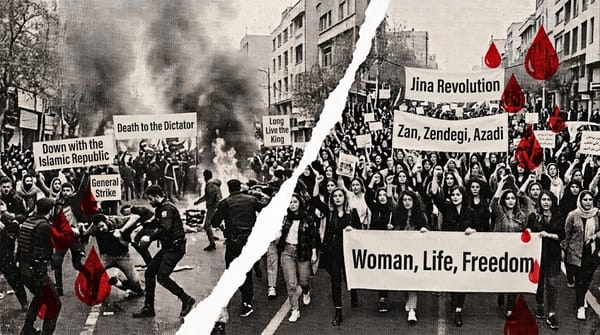
This essay argues that, after the crisis unleashed by the Woman, Life, Freedom movement, the Islamic Republic made tactical retreats in the cultural sphere in an attempt to contain its crisis of legitimacy. At the same time, however, it pursued with still greater force an economic programme of structural adjustment, passing the costs of the crisis on to Iran’s lower classes. The deepening currency collapse, the spread of labour and professional protests, and the gradual return of repressive policies all suggest that these social concessions were not signs of reform, but elements in a strategy for restoring authority. Official discourse, meanwhile, has turned to nationalism in an effort to obscure social and class divisions beneath the spectre of foreign threat. Yet the increasingly close alliance between demands for material security and demands for freedom has begun to expose the limits of this strategy.
The Woman, Life, Freedom protests produced the deepest crisis of legitimacy the Islamic Republic has faced since its founding. The conspicuous presence of women, the young, and sections of the working class, together with the high cost of suppressing them, confronted the regime with a crisis that made the simple continuation of its previous policies difficult. The state managed to contain the street protests by relying on its security apparatus, but it never succeeded in returning society to where it had stood before September 2022. What can be seen today in the streets of Tehran and other cities is a continuation of the same conflict, now enlarged by economic crisis, the collapse of the national currency, and regional tensions.
Once the protests had partially subsided, the conduct of the state began to change. In many cities, the policing of women’s dress became less severe. Some cultural restrictions were no longer enforced with their former rigidity. A practical retreat took shape, though it was never formally acknowledged. This change did not arise from reform within the structure of power. It reflected a new balance of forces, one that society had imposed upon the state. The authorities had learned that the most stringent forms of social control now carried costs greater than the machinery of repression could comfortably bear. They therefore eased some pressures in order to buy time for rebuilding their security capacity and political control, without altering either economic policy or the structure of power itself.
A Besieged Economy, Passing the Crisis Downwards
The principal site of Iran’s present crisis is not culture but political economy. The Islamic Republic has maintained its position against a discontented society through a combination of political repression and the relentless transfer of economic costs to the lower classes. In recent years, price liberalisation, the gradual removal of social protections, rent-seeking privatisation, and structural-adjustment policies have continued without interruption. Workers, pensioners, teachers, and salaried employees have borne the greater part of the burden.
The escalation of military tensions and the currency crisis have carried this process into a new phase. The dollar’s rise towards 190,000 tomans was not simply movement in an economic indicator. It meant another collapse in purchasing power, higher prices for basic goods, medicine, and housing, and the disappearance, for millions of households, of any possibility of planning their material lives. Accelerating inflation, particularly in healthcare, has fallen most heavily upon those with low incomes. Many families have been forced to choose between medical treatment and the elementary necessities of life.
In such circumstances, the protests by shopkeepers at Tehran’s Alaeddin and Chaharsou mobile-phone markets (December 28-29, 2025) should not be understood as merely sectional grievances. They are an expression of a crisis that, day by day, erodes the working capital of much of the urban petty bourgeoisie. At the same time, the security forces’ assault on a gathering of drivers, using tear gas and batons, demonstrated once again that the state’s response to material demands, no less than to political ones, rests upon coercion rather than negotiation.
Nor are these protests isolated. Oil workers, railway activists, university employees, dismissed academics, and other occupational groups have all, in recent weeks, protested in various ways against the state’s economic and security policies. The significance of these actions lies not merely in their extent, but in the growing connection between economic and political demands. When protests over wages and job security are voiced alongside demands for justice for the dead and freedom for political prisoners, the boundary between the struggle for subsistence and the struggle for liberty becomes increasingly difficult to discern.
This crisis should not be attributed solely to sanctions or mismanagement. Sanctions and war have intensified it, but its source lies in a structure that has, over decades, shifted the costs of capital accumulation on to the majority through inflation, currency depreciation, and the weakening of labour. Powerful sectors of the economy tied to military and quasi-state institutions have meanwhile remained beyond public scrutiny or accountability. The present crisis, then, is less the product of external pressure than an expression of the economic and class logic embedded in the structure of power.
Nationalism as a Means of Reconstituting Legitimacy
Whatever one’s military or geopolitical assessment of the Twelve-Day War and its aftermath, the conflict offered the Islamic Republic a new opportunity to reconstruct its official discourse. For four decades, the regime had grounded its legitimacy largely in an Islamic-revolutionary ideology. This time, more than ever before, it turned to the language of nationalism. Words such as “Iran”, “homeland”, “territorial integrity”, and “national defence” became the organising terms of official propaganda, as state media attempted to make the government synonymous with the defence of the country.
The turn was not accidental. After the crisis of legitimacy produced by the 2022 protests, followed by a succession crisis, the state needed a framework capable of redescribing political and social divisions as questions of “national unity”. An external threat supplied the ideal setting. In conditions of war, or near-war, appeals to national solidarity can become a means of pushing domestic grievances to the margins.
Yet this discourse is in open conflict with the realities of the state’s economic and social policies. Even as officials speak of a “proud Iran” and “national solidarity”, they continue to withdraw material support, raise the cost of living, and pass the weight of the economic crisis on to the majority. Pressure on civil-society activists, independent occupational organisations, ethnic and linguistic minorities, and political opponents has not ceased either. Official nationalism therefore represents less an inclusive project of nation-building than an instrument for restoring political legitimacy and managing crisis.
The contradiction becomes sharper still when the state calls upon the public to make sacrifices in defence of the country while pursuing policies that consign much of that same public to poverty, precarious employment, and the continual erosion of purchasing power. Under such conditions, class divisions are neither concealed by national rhetoric nor deprived of their force. On the contrary, they become one of the principal causes of political legitimacy’s decay.
The Return of a Familiar Pattern, Tactical Retreat and Renewed Repression
Once the atmosphere of war had begun to recede, one might have expected the state to preserve, at least for a time, its limited social flexibility. Events of recent weeks suggest otherwise. The retreat appears to have been less a change of course than an interval in which the apparatus of control could be reorganised. The intensifying harassment of women, the confiscation of passports, the suspension of citizens’ mobile-phone service, the issuing of flogging sentences, and growing pressure upon cafés, civil institutions, and labour activists all point to the gradual return of a familiar authoritarian pattern.
The machinery of execution has continued to operate at its former pace. Harsh sentences for civil and labour activists, pressure on political prisoners, and the continuing hunger strikes of prisoners under sentence of death demonstrate that the state did not suspend domestic repression even at the height of external crisis. The denial of political prisoners’ most basic rights, including restrictions on visits and harsher disciplinary measures, forms part of the same strategy.
The pattern has a long history in the Islamic Republic. Whenever confronted by a general crisis, the state has reduced certain social pressures and displayed signs of flexibility. As soon as it believed that the balance of forces had shifted in its favour, it resumed policies of control and repression with greater intensity. Temporary retreats should therefore not be mistaken for structural reform or a change in the nature of the regime. They are better understood as part of the machinery of crisis management in authoritarian states, a means of buying time, rebuilding legitimacy, and restoring the capacity for repression.
A Society That Will Not Return to the Past
Despite the return of repressive policies, Iranian society is no longer the society that existed before September 2022. Street protests may ebb, but many of the social changes they revealed appear irreversible. The spread of civil disobedience, the decline of the state’s cultural authority, and the growing convergence of occupational demands with aspirations for freedom cannot be contained by security measures alone.
Protests by workers, teachers, pensioners, drivers, bazaar merchants, and other social groups show that the demand for a livelihood can no longer be separated from the demand for freedom. Economic crisis has transformed disputes over wages, job security, and inflation into political questions. Political repression, in turn, intrudes ever more deeply into everyday life and material survival. The distinction between economic and political protest grows fainter by the day.
Iranian society now confronts two threats at once. On one side stand war, regional instability, and foreign intervention. On the other stand persistent authoritarianism and the unceasing transfer of the economic crisis to the majority. The experience of countries across the region has shown that foreign war and domestic despotism frequently reinforce one another, and that ordinary citizens are the chief victims of both. To reduce Iran’s future to a choice between these two poles is itself part of the present political impasse.
In these circumstances, the defence of peace cannot be separated from the defence of freedom and social justice. Opposition to war and foreign intervention does not require silence about repression at home, just as the struggle against despotism cannot be allowed to justify external pressure or war. Both courses ultimately exact their highest price from the lower classes and the working class.
Seen in this light, strengthening independent civil and occupational institutions, from trade unions and teachers’ associations to student groups and local networks, is not merely a democratic demand. It is the necessary condition for the emergence of a social force capable of resisting both domestic authoritarianism and the hazards of war. Recent protests have shown that wherever independent, horizontal ties among social groups have grown stronger, so too has the capacity for collective resistance.
The difficulty of this path should not be understated. Widespread repression, security laws, the penetration of organisations by intelligence bodies, and severe restrictions on labour activism all present formidable obstacles to independent organisation. Yet the persistence of scattered protests shows that, contrary to the wishes of the state, society has not lapsed back into passivity.
Iran’s future will be determined neither simply by the disposition of forces at the apex of power nor by the decisions of foreign states. It will turn on society’s ability to create durable forms of independent organisation and transform dispersed acts of resistance into collective action. If material demands, aspirations for freedom, and the desire for peace can be brought together within a common horizon, a social alternative to the cycle of war, authoritarianism, and poverty may yet take shape.
The state’s tactical retreats, like its periodic returns to repression, do not mark the end of this conflict. So long as the crisis of political legitimacy and the crisis of material survival endure together, the struggle between society and the state will continue. The central question, then, is neither whether reform will arrive from above nor whether salvation will come from abroad. It is how society’s capacity for self-organisation might be strengthened, how the demand for bread might be joined to the demand for freedom, and how peace, social justice, and democracy might be defended at once.
23 Mordad 1405 / 14 August 2026
© IranDraft
Glossary and Notes
Balance of forces
The relative power of contending social and political actors at a particular moment. Here, it describes the pressure exerted by society after the Woman, Life, Freedom protests, which altered what the state could enforce at an acceptable cost.
Crisis of legitimacy
A condition in which a political order’s claim to rule is no longer broadly accepted as rightful. A government may retain coercive control while losing the consent, trust, or ideological authority on which stable rule depends.
Structural adjustment
An economic programme commonly associated with price liberalisation, subsidy cuts, privatisation, reduced public provision, and labour-market discipline. The essay uses the term critically, emphasising how the burdens of such policies fall unevenly across classes.
Rent-seeking privatisation
The transfer of public assets not through genuinely competitive markets but through privileged access, patronage, and political connections. In Iran, this often refers to acquisitions benefiting quasi-state, military-linked, or well-connected economic interests.
Urban petty bourgeoisie
Small proprietors, shopkeepers, traders, and self-employed people whose economic position lies between wage labour and large capital. Their businesses may be especially vulnerable to inflation, currency volatility, and the loss of working capital.
Capital accumulation
The process by which profits and assets are expanded and concentrated. The article argues that the social costs of this process have been displaced on to the majority through inflation, weakened wages, and currency depreciation.
Authoritarian crisis management
A pattern in which a state temporarily relaxes social controls during periods of acute pressure, then renews repression once it has regained capacity or judged the balance of forces more favourable.
Horizontal ties
Networks of cooperation among citizens and social groups that do not depend on direction from the state or a central hierarchy. Such ties can connect otherwise dispersed protests and make sustained collective action possible.
Self-organisation
The capacity of people to build durable, independent associations and forms of collective action without direction from state institutions or external powers.
We are dedicated to looking beyond headlines.
We bring the full story and context to you when it comes to news from Iran.